

Thursday, November 09, 2023

The Invisible Court's Verdict: You Are Hereby Exiled to Digital Siberia

As in the Gulag it replicates, the innocent are swept up with the guilty in a disconcertingly unjust ratio.

The human mind is not particularly well-adapted to polycrisis: we struggle to adapt to the drought, then the earthquake knocks down the village walls, then the tsunami pounds what was left, followed by the epic flooding, then the hurricane batters the survivors, who witness the volcano erupting and wonder what they did to anger the gods and goddesses so mightily.

Now put yourself in the shoes of those tasked with governing / leading the traumatized, overwhelmed masses. If you call a public meeting to hear what the masses reckon are causes and solutions, you find a near-riot of vociferous wrangling over the equivalent of how many angels can dance on the head of a pin: all sound and fury, signifying nothing.

With the populace stripped of the sense that things are still under control, the emotions being bared put a blow-torch to civility and common sense: the toxicity of the indignation (this shouldn't be happening to me), entitlement, grievances, resentment, distress, angst and accusations knows no bounds.

This fuels a searing desperation to pin the collapse of what was known and predictable on some villainous force or cabal, and so witch hunts proliferate and wild theories gain adherents who found little solace in the official pablum (everything's fine, we have it all under control).

The voices murmuring that this is what we deserve for our hubris and pride are lost in the cacophony.

So what's your instinctive response as someone in authority to this bedlam? Try to regain some control by getting everyone on the same page. The free-for-all didn't fix anything, and so our instinct as leaders is to circle the wagons, tighten control of available resources and dampen or shut down the cacophony feeding the divisive, deranging emotions.

While it's ghoulishly entertaining to use ChatAI to translate the cries of those swept away into whatever language you prefer and watch the videos that fade to black as the camera came to a bleak end, the technological genies afoot are obvious allies in the campaign to quiet the voices feeding the bedlam.

And so Big Tech is persuaded to do its public duty to tamp down the voices threatening to spin the collective distress out of control. The obvious tools to do so are algorithmic, i.e. automate the survey and weeding out of disruptive voices, regardless of their source.

Despite claims to the contrary, algorithms aren't that smart and neither are LLMs (large language model software that uses natural language as its interface with human users).

Algorithms and other software are blind to the fact that they're in effect courts of inquiry and judgment that make assessments and sentence the accused in the blink of an eye, with minimal evidence, no hearing and no recourse, i.e. no appeal process. The verdict issued is final.

And since this entire process must be kept secret lest it arouse further tumult, the automated courts do not notify those sentenced of their verdict: we don't receive a court declaration--you are hereby sentenced to exile in Digital Siberia--you infer it when you awaken alone in the snow drifts of a vast wilderness. No one hears your digital shouts or sees your digital footprints.

As in the Gulag it replicates, the innocent are swept up with the guilty in a disconcertingly unjust ratio. Use the wrong word or phrase in a public text, podcast or video, and the secret court concludes you are an agent of intentional upheaval and chaos.

The secret courts are good at covering their tracks and subtle in their ways. You might think your digital footprint remains visible to all, and then you notice your income has collapsed. Your sentence: demonetized. Funny how quiet people get once their income vanishes.

This desire to herd everyone into a common understanding of the polycrisis is understandable, but the blunt instruments being deployed undermine our collective effort. If in fact foreign agents are spreading fentanyl and similarly destructive fabrications and distortions in the digital realm, then that demands a legitimate effort to identify and cut off these incitements of disunity and despair.

But automating the verdicts and sentencing end up hurting the nation in other profound ways. Skeptical inquiry and dissent are essential dynamics in democracy and the processes of experimentation at the heart of science and innovation.


If you're lucky, you'll locate another exile in the wastelands.


Is a 70% Consumption Economy Sustainable? (43:53 min).


My new book is now available at a 10% discount ($8.95 ebook, $18 print): Self-Reliance in the 21st Century.

Read the first chapter for free (PDF)

Read excerpts of all three chapters

Podcast with Richard Bonugli: Self Reliance in the 21st Century (43 min)


My recent books:

Disclosure: As an Amazon Associate I earn from qualifying purchases originated via links to Amazon products on this site.

The Asian Heroine Who Seduced Me (Novel) print $10.95, Kindle $6.95 Read an excerpt for free (PDF)

When You Can't Go On: Burnout, Reckoning and Renewal $18 print, $8.95 Kindle ebook; audiobook Read the first section for free (PDF)

Global Crisis, National Renewal: A (Revolutionary) Grand Strategy for the United States (Kindle $9.95, print $24, audiobook) Read Chapter One for free (PDF).

A Hacker's Teleology: Sharing the Wealth of Our Shrinking Planet (Kindle $8.95, print $20, audiobook $17.46) Read the first section for free (PDF).

Will You Be Richer or Poorer?: Profit, Power, and AI in a Traumatized World
(Kindle $5, print $10, audiobook) Read the first section for free (PDF).

The Adventures of the Consulting Philosopher: The Disappearance of Drake (Novel) $4.95 Kindle, $10.95 print); read the first chapters for free (PDF)

Money and Work Unchained $6.95 Kindle, $15 print)
Read the first section for free


Become a $1/month patron of my work via patreon.com.

Subscribe to my Substack for free


NOTE: Contributions/subscriptions are acknowledged in the order received. Your name and email remain confidential and will not be given to any other individual, company or agency.

Thank you, Richard S. ($50), for your magnificently generous patronage to this site -- I am greatly honored by your steadfast support and readership.


Thank you, Tommy J. ($5/month), for your superbly generous subscription to this site -- I am greatly honored by your support and readership.


Thank you, Richard S. ($50), for your splendidly generous contribution to this site -- I am greatly honored by your steadfast support and readership.


Thank you, William H. ($150), for your outrageously generous contribution to this site -- I am greatly honored by your steadfast support and readership.

Read more...

Monday, November 06, 2023

Who's Wealth Will Get "Clawed Back" First?

Politically, what's the easier play: cut entitlements, the vast majority of which flow to the bottom 90%, or "claw back" the ill-gotten gains of the top 1%?

Since we're discussing wealth, income and taxes, let's stipulate a few things at the start:

1. The households with the highest incomes pay the majority of federal taxes. The top 1% collected 22% of all income and paid 45% of personal federal income taxes.

The top 10% earned about 50% of all income and paid 74% of personal federal income taxes. The bottom 50% earned 10% of total income and paid 2% of income taxes. Tax Shares in Tax Year 2020.

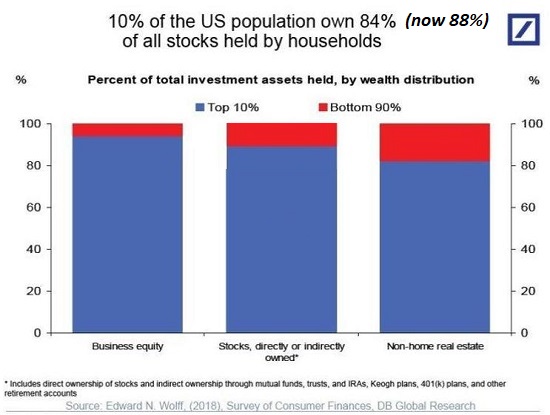
2. This reflects the reality that income and wealth are highly concentrated in the top households in the U.S. I posted the Federal Reserve charts here: How Great Is Our Economy If the Bottom 50%'s Share of the Nation's Wealth Has Plummeted Since 2009?. The bottom 50% own 2.3% of financial assets, the top 1% own 35.3% of financial assets. As this chart shows, the top 10% own the vast majority of income-producing assets: stocks and bonds, business equity and rental income property:


3. The biggest tax burden for most of the bottom 75% is Social Security / Medicare taxes paid out of wages. Earnings above $160,200 are not subject to Social Security tax.

4. The wealthy have tax break strategies that are unavailable to the middle class. One common strategy is to borrow living expenses rather than sell assets that would generate capital gains and thus capital gains taxes. The wealthy can live on borrowed money and thus declare no income and pay no taxes. ProPublica Shows How Little the Wealthiest Pay in Taxes: Policymakers Should Respond Accordingly.

5. Capital gains are highly contentrated in the top 1% of households, who received 75% of the taxable long-term capital gains. The top capital gains tax rate is 20% (plus 3.8% above $200,000, for a maximum of 23.8%), while the top rate for earned income is 37%. Source).

The Distribution of Household Income. (CBO)

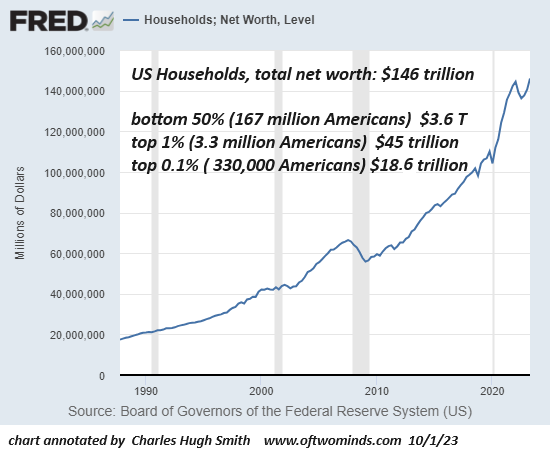
6. Total household net worth is about $146 trillion. Total personal income in the US is around $22 trillion annually.


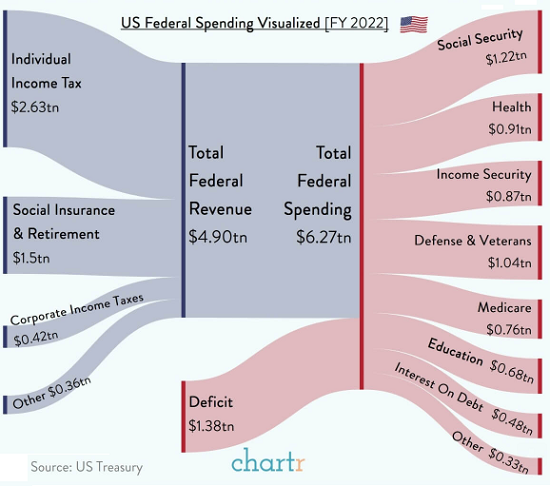
7. The federal budget was $6.3 trillion in 2022, of which $1.4 trillion was borrowed (i.e. deficit spending).


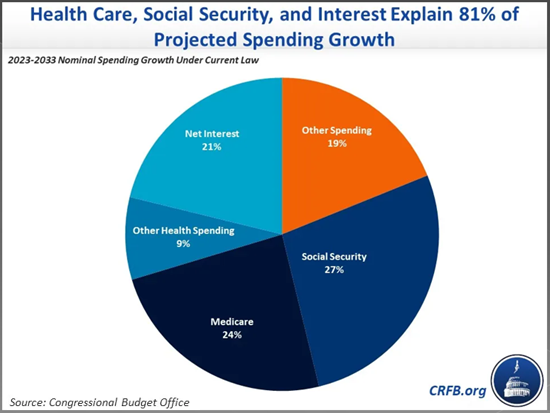
Roughly 80% of the projected future growth of federal spending is mandatory spending on entitlements and interest due on the federal debt:


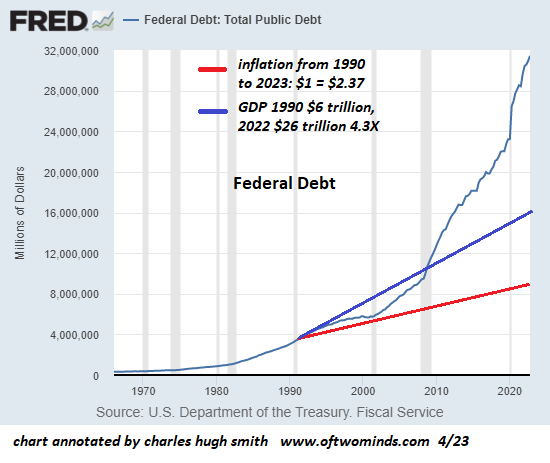
8. Federal debt is $33 trillion and rising at a parabolic rate far above the rate of GDP growth or inflation.


9. Personal income taxes collected rose sharply since 2020, from $1.6 trillion to $2.4 trillion. Per the above data, the majority of the higher tax revenues were paid by the top earners / those declaring capital gains.


Putting this together:

A. Federal spending will continue to rise sharply for decades
to fund soaring Social Security, Medicare / Medicaid entitlements and the fast-rising interest due on skyrocketing federal debt, much of which is borrowed at much higher rates than in the recent past.

B. Borrowing tens of trillions of dollars of additional debt that accrues interest is not viable unless tax revenues rise substantially to pay the higher interest costs and reduce the sums that must be borrowed.

C. The bottom 75% have very limited wiggle-room to pay higher taxes. They're struggling to pay the rising cost of living as it is. They pay 11% of income taxes, any tax increases on these 100 million households will not yield enough to make it worth the political risk.

D. The 20 million upper-middle class households between 75% and the 90% pay about 15% of federal income taxes. They can be squeezed for a bit more, but since they don't own much in the way of income-producing wealth, there's not much potential to raise serious sums from this cohort.

E. The only real potential for raising additional tax revenues is in the top 10% who own roughly 90% of all income-producing wealth. And since this ownership of income / capital gains-yielding assets is concentrated in the top 5%, that's the only deep-pocketed source of consequentially higher tax revenues that can be tapped.

Many people are concerned that the IRS will blanket the nation with tax audits aimed at the middle class. I tend to think this is unlikely because the middle class has so few dodgy tax strategies. Auditing the bottom 75% is a waste of time, as their income and tax rates are so low that whatever could be skimmed isn't worth the effort.

Even upper-middle class income is mostly earned, and there's simply not much the average upper-middle class household can do to limit their tax burden, other than save money in self-directed 401K retirement plans and similar transparent strategies.

To really raise tax revenues, regulations / tax laws will have to change to close the loopholes used by the top 1% and top 0.1%. Given that much of this wealth / income is unearned, i.e. the happy result of debt-based asset bubbles in income-producing assets, then closing loopholes that are unavailable to the merely wealthy will likely be framed as "clawing back" income that evaded the taxes paid by the merely wealthy and upper middle class.

Politically, what's the easier play: cut entitlements, the vast majority of which flow to the bottom 90%, or "claw back" the ill-gotten gains of the top 1%?. Which one is more likely to be popular with voters? Yes, the top 0.1% fund the campaigns, but political survival will demand adjustments in what's possible and what's impossible.


Is a 70% Consumption Economy Sustainable? (43:53 min).


My new book is now available at a 10% discount ($8.95 ebook, $18 print): Self-Reliance in the 21st Century.

Read the first chapter for free (PDF)

Read excerpts of all three chapters

Podcast with Richard Bonugli: Self Reliance in the 21st Century (43 min)


My recent books:

Disclosure: As an Amazon Associate I earn from qualifying purchases originated via links to Amazon products on this site.

The Asian Heroine Who Seduced Me (Novel) print $10.95, Kindle $6.95 Read an excerpt for free (PDF)

When You Can't Go On: Burnout, Reckoning and Renewal $18 print, $8.95 Kindle ebook; audiobook Read the first section for free (PDF)

Global Crisis, National Renewal: A (Revolutionary) Grand Strategy for the United States (Kindle $9.95, print $24, audiobook) Read Chapter One for free (PDF).

A Hacker's Teleology: Sharing the Wealth of Our Shrinking Planet (Kindle $8.95, print $20, audiobook $17.46) Read the first section for free (PDF).

Will You Be Richer or Poorer?: Profit, Power, and AI in a Traumatized World
(Kindle $5, print $10, audiobook) Read the first section for free (PDF).

The Adventures of the Consulting Philosopher: The Disappearance of Drake (Novel) $4.95 Kindle, $10.95 print); read the first chapters for free (PDF)

Money and Work Unchained $6.95 Kindle, $15 print)
Read the first section for free


Become a $1/month patron of my work via patreon.com.

Subscribe to my Substack for free


NOTE: Contributions/subscriptions are acknowledged in the order received. Your name and email remain confidential and will not be given to any other individual, company or agency.

Thank you, Mark J. ($50), for your magnificently generous patronage to this site -- I am greatly honored by your steadfast support and readership.


Thank you, Gary S. ($5/month), for your superbly generous subscription to this site -- I am greatly honored by your support and readership.


Thank you, Wayne K. ($50), for your splendidly generous contribution to this site -- I am greatly honored by your steadfast support and readership.


Thank you, Brenda W. ($50), for your marvelously generous contribution to this site -- I am greatly honored by your steadfast support and readership.

Read more...

Thursday, November 02, 2023

How Much Do You Spend on Food?

Maybe the question isn't just "how much do you spend on food," but "what value are you getting for what you spend in time and money for food?"

We all know food has become much more expensive, so it makes sense to pay attention to what we're paying for in terms of value, nutrition and money.

One advantage of a low/sporadic self-employed income is it trains us to track expenses. Maintaining spreadsheets of income and expenses become second-nature because it's required for tax filings.

It's easier to cut spending than earn more net income, and the obvious way to save money is to manage expenses to be lower than net income. Like many others who chose self-employment at a young age, I've kept records of expenses for decades.

Out of curiosity, I prepared a spreadsheet of our total spending on food this year. This is all food, both food prepared at home and takeout and eating out. Alcohol and household supplies (detergent, etc.) are separate categories. (I'm mostly Irish-Scots, so Guinness has its own column.)

I have no idea what other households spend, or what's considered "normal," but we spend $40 per person per week, for 21 meals at home every week (no takeout or eating out), or about $2 per meal per person.

What works for us is pretty much the way most people lived a few generations ago:

1. We stick to real food, so no processed foods, chips, frozen pizzas, meals in a plastic bag, sugary drinks, sugary cold cereals, desserts, etc. Real food can be canned (tuna, sauerkraut, etc.) or frozen (edamame, etc.), but real food doesn't have dozens of weird ingredients in fine print.

2. We eat a wide variety of foods prepared in a range of cuisines. We tend to eat what's in season (i.e. what we're harvesting from our yard and what's on sale) and our default diet is mostly Asian staples: brown rice, tofu, natto, stir-fried vegetables with a bit of meat, etc. Other than the requirement that the food is real / unprocessed, our only other guideline is minimize oils, sugar and salt. We cook Italian, Thai, Indian, Chinese, French, Hawaiian, etc.

3. We have an urban yard with fruit trees and vegetable gardens. I'm attentive to the dirt and don't use pesticides or herbicides but am otherwise a lazy gardener. There's weeds and bugs. Sometimes what you harvest looks great, other times, not, so you trim off the bad bits.

Not everyone has the land for a garden. When I lived in an apartment, I signed up for a community garden plot. Going back a few generations, it was common to have a garden.

4. We don't waste food. Again, this was once second nature to most people. Collectively, we toss out an astounding quantity of perfectly good food.

5. Preparing good food comes first, everything else comes second. According to surveys, many people complain that they don't have time to prepare meals but they manage to find 4.5 to 8 hours a day for screentime on social media, TV, "news," etc. We like to eat good food, so that's our priority. Preparing food is enjoyable and rewarding. Watching deranging SOS (same old stuff)--it's certainly addicting by design, but doesn't offer much in the way of the joy and pleasure of preparing good food.

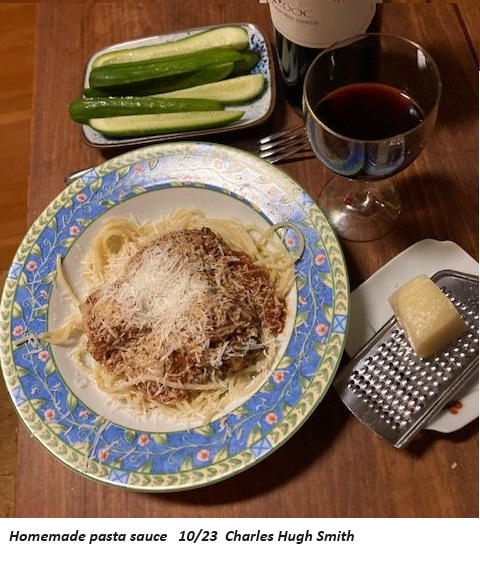
When you make your own pasta sauce from scratch, for example, you control the quality of the ingredients, and if you make a big pot, then you get the bonus of leftovers. Pasta sauce made from fresh tomatoes from a well-tended garden tastes so much better than the canned / bottled variety. It's a revelation, like many other home-prepared foods: homemade pickles, etc.

6. Takeout and restaurant food / fast-food doesn't appeal to us. It's too rich, greasy, salty, sweet or overly processed for our tastes. It's also pricey, and the taste/nutritional value simply isn't there. Comfort food is what's prepared in our kitchen.

7. We're physically active. We're full at every meal but remain lean. The "miracle health pill" doesn't exist, and never will. An active lifestyle and diverse diet of real food and minimal oils, sugar and processed food is the "miracle." Unfortunately, it's not very profitable.

8. Real food tastes better than processed food, and it's full of nutrients, unlike processed foods. Real food doesn't derange your body and mind, and so handfuls of meds are not required to be healthy. Whatever fats and sugars that are in real food are good for us. There's no need to obsess about endless restrictions. Just eat real food, the closer to the source the better. If you care about your soil and your animals, then your food will be healthy.

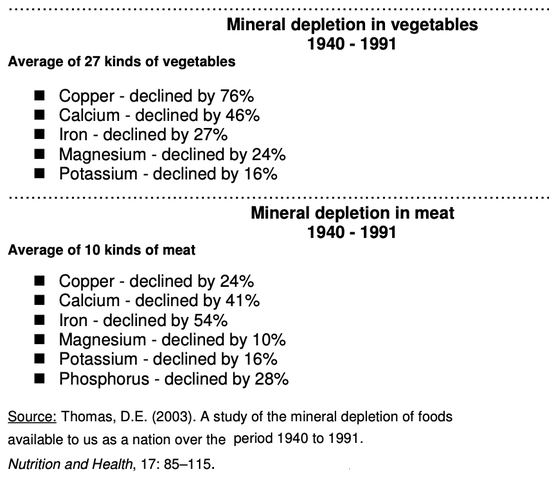
As for industrial-scale food, it isn't what it used to be in terms of nutritional value. The way we grow food on an industrial scale has led to a decline in the nutrient quality of food in general:


Maybe the question isn't just "how much do you spend on food," but "what value are you getting for what you spend in time and money for food?" I have no idea if $40 per person per week is cheap or expensive in terms of money, but I know we're getting value in terms of taste and nutrition, just like people did a few generations ago.

None of this is new; it's the way most people lived until highly processed food and greasy, sugary junk food became profit centers. A greasy, sugary snack? Immensely profitable. A raw carrot or apple--not so much.


Is a 70% Consumption Economy Sustainable? (43:53 min).


My new book is now available at a 10% discount ($8.95 ebook, $18 print): Self-Reliance in the 21st Century.

Read the first chapter for free (PDF)

Read excerpts of all three chapters

Podcast with Richard Bonugli: Self Reliance in the 21st Century (43 min)


My recent books:

Disclosure: As an Amazon Associate I earn from qualifying purchases originated via links to Amazon products on this site.

The Asian Heroine Who Seduced Me (Novel) print $10.95, Kindle $6.95 Read an excerpt for free (PDF)

When You Can't Go On: Burnout, Reckoning and Renewal $18 print, $8.95 Kindle ebook; audiobook Read the first section for free (PDF)

Global Crisis, National Renewal: A (Revolutionary) Grand Strategy for the United States (Kindle $9.95, print $24, audiobook) Read Chapter One for free (PDF).

A Hacker's Teleology: Sharing the Wealth of Our Shrinking Planet (Kindle $8.95, print $20, audiobook $17.46) Read the first section for free (PDF).

Will You Be Richer or Poorer?: Profit, Power, and AI in a Traumatized World
(Kindle $5, print $10, audiobook) Read the first section for free (PDF).

The Adventures of the Consulting Philosopher: The Disappearance of Drake (Novel) $4.95 Kindle, $10.95 print); read the first chapters for free (PDF)

Money and Work Unchained $6.95 Kindle, $15 print)
Read the first section for free


Become a $1/month patron of my work via patreon.com.

Subscribe to my Substack for free


NOTE: Contributions/subscriptions are acknowledged in the order received. Your name and email remain confidential and will not be given to any other individual, company or agency.

Thank you, Hou T. ($54), for your magnificently generous patronage to this site -- I am greatly honored by your steadfast support and readership.


Thank you, Richmond A ($5/month), for your superbly generous subscription to this site -- I am greatly honored by your support and readership.


Thank you, Alain M. ($50), for your splendidly generous contribution to this site -- I am greatly honored by your steadfast support and readership.


Thank you, David K. ($200), for your outrageously generous contribution to this site -- I am greatly honored by your steadfast support and readership.

Read more...

Tuesday, October 31, 2023

We're Eating Our Seed Corn

What will break is not as predictable as the reality that the current trajectory is untenable and unsustainable.

If we're limited to our income, there's only so much we can spend on consumption and servicing existing debts, and invest / save to build capital / future income.

If we have access to the miraculous elixir of credit, we can expand our spending / investing by borrowing more money. This boosts our consumption and perhaps our investing, but it also increases our debt service--the interest that must be paid on debts old and new.

When interest rates are near-zero / less than inflation, this burden is light. Once interest rates return to historic norms, however, large debt loads generate large interest payments, and the elixir of credit becomes a toxin sapping th borrower of income and an unencumbered future: rather than having the option of saving income to invest in the future, the borrower must devote an increasing share of income to debt service.

Unless income is rising faster than debt service, the tapeworm of debt service starves the borrower. This dual nature of debt--elixir and toxin--is scale-invariant, meaning that it functions in the same manner on the small scale of households all the way up to nation-states.

The vast horde of cheerleaders of debt always claim "we'll grow our way out of debt": by investing the borrowed money in wonderfully productive things, the economy (and household income, corporate profits, etc.) will grow so smartly that the debt service will remain a paltry and inconsequential percentage of spending.

The rosy forecast is the U.S. is investing in reshoring / re-industrialization / energy transition, and all these will jump-start growth for decades to come. Yes, we're borrowing trillions of dollars, but these dollars are being wisely invested in future productivity and improved national security.

The cheerleaders point to the history of the past 60 years as proof that this dynamic of "growing our way out of debt" can be counted on into the future.

Nice, but the cheerleaders forgot what happened in the 1970s, a decade of high inflation, rising costs and uneven expansion. The conventional explanation for this stagflation focuses on the "oil shock" of sharply higher oil prices in 1973-74, the rise of global competition and rising bond yields / interest rates.

But as I explained in The Forgotten History of the 1970s (1/13/23), a major contributor to the stagflation was the enormous investments that were poured into cleaning up America's polluted air and water, and re-engineering the nation's industrial base to be cleaner and more efficient.

The eventual payoff was huge, but it took decades to reap the rewards, which in this case included restored waterways (The 1970s: From Rotting Carcasses Floating in the River to Kayak Races 1/22/23) and a more efficient industrial base.

Note that this enormous investment did not generate more corporate profits or consumption. From the point of view of "growth," it was a monumental money-pit, for the pay-off--a cleaner environment--did not generate profits or growth until far down the road.

The same dynamic will play out in the vast sums that must be sunk into reshoring / re-industrialization / energy transition, a process that raises costs for years or even decades before the eventual benefits outweigh the enormous costs.

Given higher rates of interest, borrowing trillions to fund both consumption and investment is in effect eating our seed corn as consumption isn't an investment that generates a return, and the return on vast investments with payoffs far down the road will jack up interest payments and other costs without generating the "growth" cheerleaders count on.

Gordon Long and I discuss what happens when "growing" consumption and investments are dependent on increasing debt faster than income in Is a 70% Consumption Economy Sustainable? (43:53 min).

The federal government has many obligations and many constituencies. Seven decades of economic expansion has raised expections of every constituency for more federal funding. This has generated what I call the Savior State, a central government tasked with meeting every constituencies' needs with few limits.

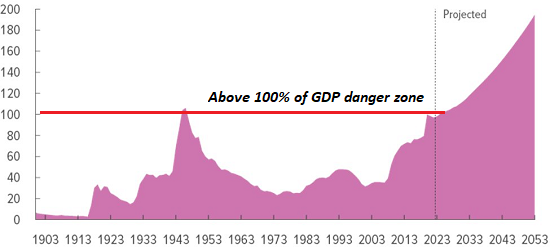
If borrowing and debt service rise faster than the returns on investment, the borrower goes broke before the return on investment catches up with the soaring cost of servicing the skyrocketing debt. Historical studies suggest problems of solvency and crimped spending arise once the national debt exceeds the national output, i.e. GDP. When debt rises above GDP, the nation starts consuming its seed corn to maintain consumption.


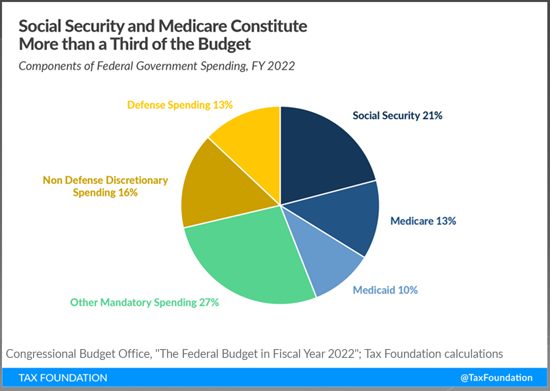
Savior States have an unsolvable problem: their social pension and healthcare programs were designed for economies with five full-time workers for every retiree. Now the ratio is closer to two-to-one: two workers (134 million full-time wage earners) for every retiree / recipient (67+ million recipients of Social Security and Medicare).

As this chart shows, social pension / healthcare programs are 44% of the federal budget (Social Security, Medicare and Medicaid).


As the cohort of beneficiaries increases and costs of healthcare increase, federal spending will rise regardless of any other factors. Since federal revenues don't cover expenditures, the Treasury is borrowing trillions of dollars, guaranteeing the interest payments of the government will rise significantly. This chart shows the projected growth of each segment, not the current expenditures.


Here's a breakdown of federal revenues and expenditures.


Can we maintain a 70% consumption economy without bankrupting the nation? Combine the vast requirements for investments with minimal immediate financial payoffs with social pension / healthcare obligations designed for an economy that no longer exists, the expectations that consumption "should" keep expanding regardless of debt / interest payments and the impossibility of funding all this out of revenues, and the answer is: something's gotta give. What will break is not as predictable as the reality that the current trajectory is untenable and unsustainable.

Is a 70% Consumption Economy Sustainable? (43:53 min).


My new book is now available at a 10% discount ($8.95 ebook, $18 print): Self-Reliance in the 21st Century.

Read the first chapter for free (PDF)

Read excerpts of all three chapters

Podcast with Richard Bonugli: Self Reliance in the 21st Century (43 min)


My recent books:

Disclosure: As an Amazon Associate I earn from qualifying purchases originated via links to Amazon products on this site.

The Asian Heroine Who Seduced Me (Novel) print $10.95, Kindle $6.95 Read an excerpt for free (PDF)

When You Can't Go On: Burnout, Reckoning and Renewal $18 print, $8.95 Kindle ebook; audiobook Read the first section for free (PDF)

Global Crisis, National Renewal: A (Revolutionary) Grand Strategy for the United States (Kindle $9.95, print $24, audiobook) Read Chapter One for free (PDF).

A Hacker's Teleology: Sharing the Wealth of Our Shrinking Planet (Kindle $8.95, print $20, audiobook $17.46) Read the first section for free (PDF).

Will You Be Richer or Poorer?: Profit, Power, and AI in a Traumatized World
(Kindle $5, print $10, audiobook) Read the first section for free (PDF).

The Adventures of the Consulting Philosopher: The Disappearance of Drake (Novel) $4.95 Kindle, $10.95 print); read the first chapters for free (PDF)

Money and Work Unchained $6.95 Kindle, $15 print)
Read the first section for free


Become a $1/month patron of my work via patreon.com.

Subscribe to my Substack for free


NOTE: Contributions/subscriptions are acknowledged in the order received. Your name and email remain confidential and will not be given to any other individual, company or agency.

Thank you, Kolya. ($50), for your magnificently generous Substack subscription to this site -- I am greatly honored by your support and readership.


Thank you, Rich P. ($50), for your superbly generous Substack subscription to this site -- I am greatly honored by your support and readership.


Thank you, Tunc K. ($50), for your splendidly generous Substack subscription to this site -- I am greatly honored by your support and readership.


Thank you, Edward D. ($50), for your marvelously generous Substack subscription to this site -- I am greatly honored by your support and readership.

Read more...

Sunday, October 29, 2023

The Counterculture Everyone Forgot

Rather than mocking the Counterculture, we would benefit from re-acquiring its values that favored frugality and the ownership of skills, work, enterprise and land.

Mention the Counterculture of the 1960s and 1970s, and the memory stored in popular culture is of drug-dazed, half-naked hippies dancing to rock music. There was a slice of that, to be sure, but there was much more that's largely been forgotten:

The Counterculture was primarily a response to the meaningless debt-dependent consumerism that had already taken hold of our society and economy. The core values of the Counterculture Everyone Forgot were:

1. Learning how to make and repair things oneself

2. Frugality

3. Rejection of debt

I submit that the value of these life precepts will become increasingly visible and necessary. As I've explained before, reliance on debt incentivizes the most destructive and unsustainable traits of human nature: choosing the painless, sacrifice-free option of pushing costs into the future, the removal of any incentive to become more productive and efficient, and the optimization of the illusion that the future will painlessly be able to not just service the current mountain of debt but an entire mountain range of debt that will pile up as our borrowing increases.

The emptiness and meaningless of consumerism has reached levels which are now actively destroying our health, as I laid out in gory detail in The Profitable Destruction of Americans' Health. The optimization of maximizing profit via monopoly/cartel profiteering, planned obsolescence and shrinflation (getting less while paying more) has stripped products and services of durability, so everything we buy is on a conveyor belt to the Landfill--the perfection of our Waste Is Growth Landfill Economy.

This conveyor belt of squandered wealth looks sustainable as long as debt can skyrocket at near-zero rates of interest. But those days are gone, never to return. Borrowing more money now costs money, and so long after the unrepairable, low-quality gew-gaw is rotting away in the landfill, the debt used to purchase it lives on, eating the borrower alive.

The secular bible of the Counterculture was the Whole Earth Catalog, a collection of quality American-manufactured tools and products designed for durability and productive use. In other words, things that aren't consumed, they're used to generate value. This concept has largely been lost: human beings are not productive beings, we're consumers, whose very identity anf existence flows from buying more of everything: I shop, therefore I am.

The depravity of borrowing money to squander on things of questionable or temporary value was visible 60 years ago, and the depravity will soon consume all those who believe this system is sustainable. What's the opposite of a depraved dependence on debt to buy stuff of questionable or temporary value? Buying tools with cash and learning how to use them to create value for oneself, one's household and one's community, and consume / share / sell what one produces.

The Counterculture questioned the value of debt and consumerism, and sought to return to the bedrock skills and values of the pre-debt/consumerism era. These included frugality--waste not, want not--in service of saving up and paying cash for everything rather than borrowing money, and in reducing dependence on the exploitive system of labor, where one sells their time (i.e. their life) for the dubious benefits of a wage.

The favored Counterculture alternative was to own your own work, own your own tools and own your own land. And by "own" we mean "own free and clear," i.e. zero debt.

One of the more popular books of the Counterculture era was How to Live on Nothing (1/1/71), an exaggeration of course, but nonetheless it offered a practical guide to spending as little as possible, for it was understood that frugality equals freedom and debt equals servitude.

In my own work, I've strived to offer alternatives to piling up debt / servitude. My book Get a Job, Build a Real Career describes an alternative to accepting a lifetime of debt /servitude for a university degree of questionable value--learn how to accredit yourself.

My book Self-Reliance in the 21st Century lays out a framework for increasing self-reliance by reducing exposure to systemic fragilities and vulnerabilities, and assembling real-world skills and assets rather than pile up more debt or depending on a government funded by debt.

Our first house was a micro-house constructed with hand tools as there was no electrical service onsite. Those who know how can do quite a bit with a sharp handsaw and other basic tools. A few years later, when we were 26 years of age, we built a "real house" ourselves, subcontracting the electrical and plumbing asd required by local building codes. We took out a local bank loan for $5,000 to finish the house and paid it off in less than two years. (In today's money, that's $17,500.) Then the house was ours, free and clear.

Frugality in service of saving and paying cash for durable value really is freedom. So is knowing how to do things so you don't have to pay others to do what you could have done yourself.

Rather than mocking the Counterculture, we would benefit from re-acquiring its values that favored frugality and self-reliance, the ownership of skills, work, enterprise and land, sharing knowledge with others and a rejection of debt as needless servitude.

These values don't disappear with financial success, for they are the bedrock of financial success. Here are my work slippers and my dress slippers, for going out into the world looking my best:


My new book is now available at a 10% discount ($8.95 ebook, $18 print): Self-Reliance in the 21st Century.

Read the first chapter for free (PDF)

Read excerpts of all three chapters

Podcast with Richard Bonugli: Self Reliance in the 21st Century (43 min)


My recent books:

Disclosure: As an Amazon Associate I earn from qualifying purchases originated via links to Amazon products on this site.

The Asian Heroine Who Seduced Me (Novel) print $10.95, Kindle $6.95 Read an excerpt for free (PDF)

When You Can't Go On: Burnout, Reckoning and Renewal $18 print, $8.95 Kindle ebook; audiobook Read the first section for free (PDF)

Global Crisis, National Renewal: A (Revolutionary) Grand Strategy for the United States (Kindle $9.95, print $24, audiobook) Read Chapter One for free (PDF).

A Hacker's Teleology: Sharing the Wealth of Our Shrinking Planet (Kindle $8.95, print $20, audiobook $17.46) Read the first section for free (PDF).

Will You Be Richer or Poorer?: Profit, Power, and AI in a Traumatized World
(Kindle $5, print $10, audiobook) Read the first section for free (PDF).

The Adventures of the Consulting Philosopher: The Disappearance of Drake (Novel) $4.95 Kindle, $10.95 print); read the first chapters for free (PDF)

Money and Work Unchained $6.95 Kindle, $15 print)
Read the first section for free


Become a $1/month patron of my work via patreon.com.

Subscribe to my Substack for free


NOTE: Contributions/subscriptions are acknowledged in the order received. Your name and email remain confidential and will not be given to any other individual, company or agency.

Thank you, Kerjanga N. ($50), for your magnificently generous Substack subscription to this site -- I am greatly honored by your support and readership.


Thank you, Richard H. ($50), for your superbly generous Substack subscription to this site -- I am greatly honored by your support and readership.


Thank you, Frank ($50), for your splendidly generous Substack subscription to this site -- I am greatly honored by your support and readership.


Thank you, Michael K. ($50), for your marvelously generous Substack subscription to this site -- I am greatly honored by your support and readership.

Read more...

Terms of Service

All content on this blog is provided by Trewe LLC for informational purposes only. The owner of this blog makes no representations as to the accuracy or completeness of any information on this site or found by following any link on this site. The owner will not be liable for any errors or omissions in this information nor for the availability of this information. The owner will not be liable for any losses, injuries, or damages from the display or use of this information. These terms and conditions of use are subject to change at anytime and without notice.

RE: European Union AI Act, and Our Use of Generative AI Tools and Agents Policy

All text on this site is composed by Charles Hugh Smith or by a credited guest-author. No Generative AI Tools are used in the composition / writing of any text or graphic content created by Charles Hugh Smith. This site deploys no AI agents or generative AI tools. This site is not responsible for the disclosures, use or non-use of AI agents or generative AI tools in advertisements displayed by Investing Channel or other ad placement services.

Audio files generated by text-to-audio transcription tools are identified as such.

Our Privacy Policy:

Correspondents' email is strictly confidential. This site does not collect digital data from visitors or distribute cookies. Advertisements served by third-party advertising networks such as Investing Channel may use cookies or collect information from visitors for the purpose of Interest-Based Advertising; if you wish to opt out of Interest-Based Advertising, please go to Opt out of interest-based advertising (The Network Advertising Initiative) If you have other privacy concerns relating to advertisements, please contact advertisers directly.

PRIVACY NOTICE FOR EEA INDIVIDUALS

This section covers disclosures on the General Data Protection Regulation (GDPR) for users residing within EEA only. GDPR replaces the existing Directive 95/46/ec, and aims at harmonizing data protection laws in the EU that are fit for purpose in the digital age. The primary objective of the GDPR is to give citizens back control of their personal data. Please follow the link below to access InvestingChannel's General Data Protection Notice.
https://stg.media.investingchannel.com/gdpr-notice/

Notice of Compliance with The California Consumer Protection Act

This site does not collect digital data from visitors or distribute cookies. Advertisements served by a third-party advertising network (Investing Channel) may use cookies or collect information from visitors for the purpose of Interest-Based Advertising. If you do not want any personal information that may be collected by third-party advertising to be sold, please follow the instructions on this page: Do Not Sell My Personal Information.

Regarding Cookies:

This site does not collect digital data from visitors or distribute cookies. Advertisements served by third-party advertising networks such as Investing Channel may use cookies or collect information from visitors for the purpose of Interest-Based Advertising; if you wish to opt out of Interest-Based Advertising, please go to Opt out of interest-based advertising (The Network Advertising Initiative) If you have other privacy concerns relating to advertisements, please contact advertisers directly.

Our Commission Policy:

Though I earn a small commission on Amazon.com books and gift certificates and gold (BullionVault) purchased via links on my site, I receive no fees or compensation for any other non-advertising links or content posted on my site.

Copyright Notice:

All original images (Drawings and Photographs), text (essays, books and works of fiction), audio and video recordings, musical compositions, graphic design, graphic design elements and HTML coding on this site are the copyrighted work of Charles Hugh Smith unless otherwise credited or noted. They are published as information for the private use of site visitors, and any reproduction or redistribution of this content or coding in any media in any format or distribution channel (text, audio, video/film, web) without the written permission of the copyright holder is strictly prohibited. All rights in all media reserved globally.

  © Blogger templates Newspaper III by Ourblogtemplates.com 2008

Back to TOP