Sunday, January 14, 2024

Self-Reliance, Taoism and the Warring States

Because the best protection isn't a 30-room bunker; it's having 30 people who care about you.

This week's focus is on self-reliance, a more complex topic than it may seem. Today's essay was first posted here on Of Two Minds on June 27, 2008, and it has elicited quite a bit of commentary over the years. I've edited it slightly for today's post.

I'm not trying to be difficult, but I can't help cutting against the grain on topics like surviving the coming bad times when my experience runs counter to the standard received wisdom.

A common thread within most discussions of surviving bad times--especially really bad times--runs more or less like this: stockpile a bunch of canned/dried food and other valuable accoutrements of civilized life (generators, tools, canned goods, firearms, etc.) in a remote area far from urban centers, and then wait out the bad times, all the while protecting your stash with an array of technology (night vision binocs, etc.)

Now while I respect and admire the goal, I must respectfully disagree with just about every assumption behind this strategy. Once again, this isn't because I enjoy being ornery but because everything in this strategy runs counter to my own experience in rural settings.

You see, when I was a young teen my family lived in the mountains. To the urban sophisticates who came up as tourists, we were "hicks" (or worse), and to us they were "flatlanders" (derisive snort).

Now the first thing you have to realize is that we know the flatlanders, but they don't know us. They come up to their cabin, and since we live here year round, we soon recognize their vehicles and know about how often they come up, what they look like, if they own a boat, how many in their family, and just about everything else which can be learned by simple observation.

The second thing you have to consider is that after school and chores (remember there are lots of kids who are too young to have a legal job, and many older teens with no jobs, which are scarce), boys and girls have a lot of time on their hands. We're not taking piano lessons and all that urban busywork. And while there are plenty of kids spending all afternoon or summer playing videogames, not every kid is like that.

So we're out riding around. On a scooter or motorcycle if we have one, but if not then on bicycles, or we're hoofing it. Since we have time, and we're wandering all over this valley or mountain or plain, one way or another, then somebody will spot that trail of dust rising behind your pickup when you go to your remote hideaway. Or we'll run across the new road or driveway you cut, and wander up to see what's going on. Not when you're around, of course, but after you've gone back down to wherever you live. There's plenty of time; since you picked a remote spot, nobody's around.

Your hideaway isn't remote to us; this is our valley, mountain, desert, etc., all 20 miles of it, or what have you. We've hiked around all the peaks, because there's no reason not to and we have a lot of energy. Fences and gates are no big deal, (if you triple-padlock your gate, then we'll just climb over it) and any dirt road, no matter how rough, is just an open invitation to see what's up there. Remember, if you can drive to your hideaway, so can we. Even a small pickup truck can easily drive right through most gates (don't ask how, but I can assure you this is true). If nobody's around, we have all the time in the world to lift up or snip your barbed wire and sneak into your haven. Its remoteness makes it easy for us to poke around and explore without fear of being seen.

What flatlanders think of as remote, we think of as home. If you packed in everything on your back, and there was no road, then you'd have a very small hideaway--more a tent than a cabin. You'd think it was safely hidden, but we'd eventually find it anyway, because we wander all over this area, maybe hunting rabbits, or climbing rocks, or doing a little fishing if there are any creeks or lakes in the area. Or we'd spot the wisp of smoke rising from your fire one crisp morning, or hear your generator, and wonder who's up there.

When we were 13, my buddy J.E. and I tied sleeping bags and a few provisions on our bikes--mine was a crappy old 3-speed, his a Schwinn 10-speed--and rode off into the next valley over bone-jarring dirt roads. We didn't have fancy bikes with shocks, and we certainly didn't have camp chairs, radios, big ice chests and all the other stuff people think is necessary to go camping; we had some matches, cans of beans and apple sauce and some smashed bread. (It didn't start out smashed, but the roads were rough.)

We camped where others had camped before us, not in a campground but just off the road in a pretty little meadow with a ring of fire-blackened rocks and a flat spot among the pine needles. We didn't have a tent, or air mattress, or any of those luxuries; but we had the smashed bread and the beans, and we made a little fire and ate and then went to sleep under the stars glittering in the dark sky.

There were a few bears in the area, but we weren't afraid; we didn't need a gun to feel safe. We weren't dumb enough to sleep with our food; if some bear wandered by and wanted the smashed bread, he could take it without bothering us. The only animal which could bother us was the human kind, and since few people walk 10 or more miles over rough ground in the heat and dust, then we'd hear their truck or motorbike approaching long before they ever spotted us.

We explored old mines and anything else we spotted, and then we rode home, a long loop over rutted, dusty roads. In summer, we took countless hikes over the mountainous wilderness behind his family cabin.

All of which is to say that the locals will know where your hideaway is because they have lots of time to poke around. Any road, no matter how rough, might as well be lit with neon lights which read, "Come on up and check this out!" If a teen doesn't spot your road, then somebody will: a county or utility employee out doing his/her job, a hunter, somebody. As I said, the only slim chance you have of being undetected is if you hump every item in your stash on your pack through trailess, roadless wilderness. But if you ever start a fire, or make much noise, then you're sending a beacon somebody will eventually notice.

The Taoists developed their philosophy during an extended era of turmoil known as the Warring States period of Chinese history. One of their main principles runs something like this: if you're tall and stout and strong, then you'll call attention to yourself. And because you're rigid--that is, what looks like strength at first glance--then when the wind rises, it snaps you right in half.

If you're thin and ordinary and flexible, like a willow reed, then you'll bend in the wind, and nobody will notice you. You'll survive while the "strong" will be broken, either by unwanted attention or by being brittle.

So let's line it all up. Isn't a flatlander who piles up a high-value stash in a remote area with no neighbors within earshot or line of sight kind of like a big, tall brittle tree? All those chains and locks and barbed-wire fencing and bolted doors just shout out that the flatlander has something valuable inside that cabin/bunker/RV etc.

Now if he doesn't know any better, then the flatlander reckons his stash is safe. But what he's not realizing if that we know about his stash and his vehicle and whatever else can be observed. If some locals want that stash, then they'll wait for the flatlander to leave and then they'll tow the RV off or break into the cabin, or if it's small enough, disassemble it and haul it clean off. There's plenty of time, and nobody's around. That's pretty much the ideal setting for leisurely thieving: a high-value stash of goodies in a remote area accessible by road is just about perfect.

Let's say the flatlander is burrowed into his cabin. Eventually some locals will come up to visit, in a truck or on foot. We won't be armed; we're not interested in taking the flatlander's life or goodies. We just want to know what kind of person he is. So maybe we'll tell him about the church food drive, or maybe ask if he's seen so-and-so around.

Now what's the flatlander going to do when several unarmed men approach? Gun them down? He can't very well conclude they're a threat and warn them off. But if he does, then we'll know he's just another selfish flatlander. He won't get any help later when he needs it; or it will be minimal and grudging. He just counted himself out.

So creating a high-value horde in a remote setting is looking like just about the worst possible strategy in the sense that the flatlander has provided a huge incentive to theft and also provided a setting advantageous to the thief.

If someone were to ask this "hick" for a less risky survival strategy, I would suggest moving into town and start showing a little generosity rather than a lot of hoarding. If not in town, then on the edge of town, where you can be seen and heard.

I'd suggest attending church, if you've a mind to, even if your faith isn't as strong as others. Or join a local service club, if you can get an invitation. I'd volunteer to help with the pancake breakfast fundraiser, and buy a couple tickets to other fundraisers in town. I'd mow the senior's lawn next door for free, and pony up a few dollars if the elderly gentleman in line ahead of me at the grocery store finds himself a few dollars light on his purchase.

If I had a parcel outside town that was suitable for an orchard or other crop, I'd plant it, and spend plenty of time in the local hardware store and farm supply, asking questions and spreading a little money around the local merchants. I'd invite my neighbors into my little plain house so they could see I don't own diddly-squat except some second-hand furniture and a crappy old TV. And I'd leave my door open so anyone could see for themselves I've got very little worth taking.

I'd have my tools, of course; but they're scattered around and old and battered by use; they're not shiny and new and expensive-looking, and they're not stored all nice and clean in a box some thief could lift. They're hung on old nails, or in the closet, and in the shed; a thief would have to spend a lot of time searching the entire place, and with my neighbors looking out for me, the thief is short of the most important advantage he has, which is time.

If somebody's desperate enough or dumb enough to steal my old handsaw, I'll buy another old one at a local swap meet. (Since I own three anyway, it's unlikely anyone would steal all three because they're not kept together. And who uses human-powered hand tools now anyway?)

Valuable things are kept hidden amidst all the low-value junk I keep around to send the message there's nothing worth looking at. The safest things to own are those which are visibly low-value, surrounded by lots of other mostly worthless stuff.

We might also ask: what's actually valuable? I've built entire houses with nothing but a wormdrive Skilsaw, tape measure, builder's square, plumb bob, snapline, level, well-worm hammer and a Yankee screwdriver. Nothing but the Skilsaw has any value; who wants old tools? It's the knowledge of how to use them productively that's valuable, but that can't be stolen. It's safely stored in the Tao of practical experience acquired over years or decades.

I'd claim a spot in the community garden, or hire a neighbor to till up my back yard, and I'd plant chard and beans and whatever else my neighbors suggested grew well locally. I'd give away most of what I grew, or barter it, or maybe sell some at the farmer's market. It wouldn't matter how little I had to sell, or how much I sold; what mattered was meeting other like-minded souls and swapping tips and edibles.

If I didn't have a practical skill, I'd devote myself to learning one. If anyone asked me, I'd suggest saw sharpening and beer-making. You're legally entitled to make quite a bit of beer for yourself, and a decent homebrew is always welcome by those who drink beer. It's tricky, and your first batches may blow up or go flat, but when you finally get a good batch you'll be very popular and well-appreciated if you're of the mind to share.

Saw-sharpening just takes patience and a simple jig; you don't need to learn a lot, like a craftsman, but you'll have a skill you can swap with craftsmen/women. As a carpenter, I need sharp saws, and while I can do it myself, I find it tedious and would rather rebuild your front porch handrail or a chicken coop in exchange for the saw-sharpening.

Pickles are always welcome in winter, or when rations get boring; the Germans and Japanese of old lived on black bread or brown rice and pickled vegetables, with an occasional piece of dried meat or fish. Learning how to pickle is a useful and easy-to-learn craft. There are many others. If you're a techie, then volunteer to keep the network up at the local school; do it for free, and do a good job. Show you care.

Because the best protection isn't a 30-room bunker; it's having 30 people who care about you. Since those 30 have other people who care about them, you actually have 300 people who are looking out for each other, including you. The second best protection isn't a big stash of stuff others want to steal; it's sharing what you have and owning little of value. That's being flexible, and common, the very opposite of creating a big fat highly visible, high-value target and trying to defend it yourself in a remote setting.

I know this runs counter to most conventional advice about self-reliance, but if you're a "hick" like me, then you know it rings true. The flatlanders are scared because they're alone and isolated; we're not scared. We've endured bad times before, and we don't need much to get by. We're not saints, but we will reciprocate to those who extend their good spirit and generosity to the community in which they live and in which they produce something of value.

Being productive, sharing and reciprocation: this is the essence of Self-Reliance, the topic of my book Self-Reliance in the 21st Century.



My new book is now available at a 10% discount ($8.95 ebook, $18 print): Self-Reliance in the 21st Century.

Read the first chapter for free (PDF)

Read excerpts of all three chapters

Podcast with Richard Bonugli: Self Reliance in the 21st Century (43 min)


My recent books:

Disclosure: As an Amazon Associate I earn from qualifying purchases originated via links to Amazon products on this site.

The Asian Heroine Who Seduced Me (Novel) print $10.95, Kindle $6.95 Read an excerpt for free (PDF)

When You Can't Go On: Burnout, Reckoning and Renewal $18 print, $8.95 Kindle ebook; audiobook Read the first section for free (PDF)

Global Crisis, National Renewal: A (Revolutionary) Grand Strategy for the United States (Kindle $9.95, print $24, audiobook) Read Chapter One for free (PDF).

A Hacker's Teleology: Sharing the Wealth of Our Shrinking Planet (Kindle $8.95, print $20, audiobook $17.46) Read the first section for free (PDF).

Will You Be Richer or Poorer?: Profit, Power, and AI in a Traumatized World
(Kindle $5, print $10, audiobook) Read the first section for free (PDF).

The Adventures of the Consulting Philosopher: The Disappearance of Drake (Novel) $4.95 Kindle, $10.95 print); read the first chapters for free (PDF)

Money and Work Unchained $6.95 Kindle, $15 print)
Read the first section for free


Become a $1/month patron of my work via patreon.com.

Subscribe to my Substack for free


NOTE: Contributions/subscriptions are acknowledged in the order received. Your name and email remain confidential and will not be given to any other individual, company or agency.

Thank you, Samuel T. ($25), for your splendidly generous contribution to this site -- I am greatly honored by your steadfast support and readership.


Thank you, Denis I. ($50), for your marvelously generous Substack contribution to this site -- I am greatly honored by your support and readership.


Thank you, Greg G. ($5/month), for your superbly generous Substack contribution to this site -- I am greatly honored by your steadfast support and readership.


Thank you, Dennis H. ($5/month), for your magnificently generous Substack contribution to this site -- I am greatly honored by your steadfast support and readership.

Read more...

Wednesday, January 10, 2024

The Chinese Connection: Here's Why Inflation Won't Fall to 2% and Stay There Indefinitely

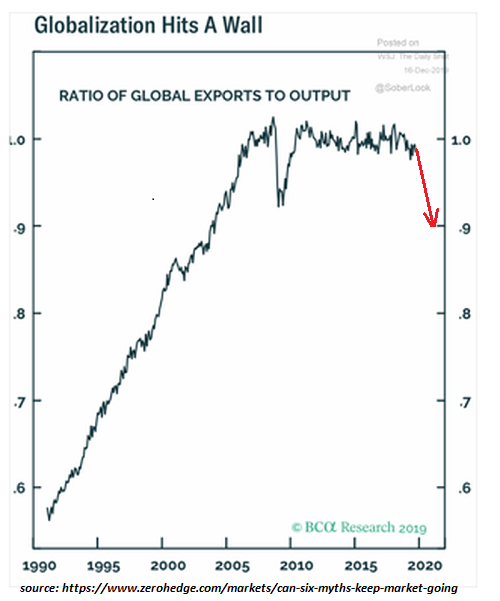
Where is the global deflator expansive enough to replace China's one-off deflation of global inflationary forces? There isn't one.

In broad brush, central banks got away with the illusion of permanently low inflation even as they pumped trillions in new currency into the global economy for one reason: China. It is useful to think of China in the early-to-mid 1990s as a system of vast, interconnected, untapped pools of:

1. Cheap labor just awaiting exploitation by global corporations, local entrepreneurs and state entities

2. Ambition, drive and long-frustrated desires for improved opportunities for individual/family betterment

3. Need for capital/credit to build a modern economy and infrastructure

4. Potential for national issuance of currency and credit on an unimaginably large scale

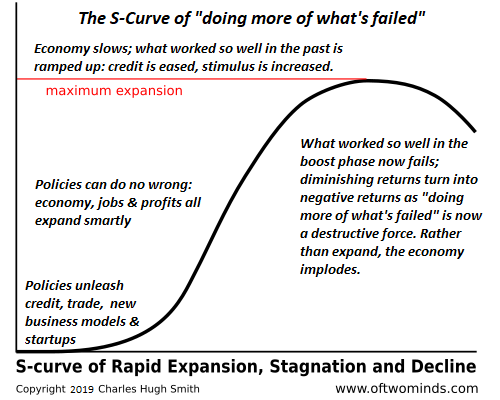
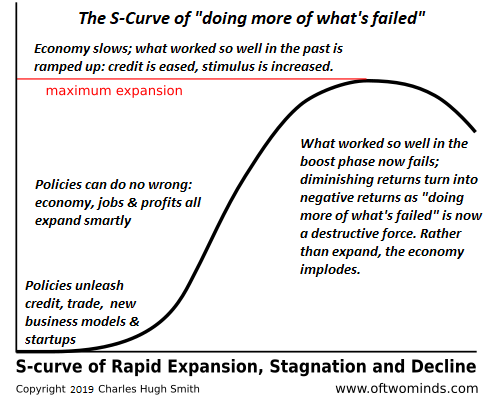
All four pools were tapped at ever larger scales over the past 30 years, enabling China to deflate the cost of good globally as "the workshop of the world." All else being equal, issuing unprecedented quantities of currency and credit, both public and private, typically boosts consumption and production in the early "boost phase" of the S-Curve. But once the most productive uses of credit are satiated, the new money flows into unproductive speculation and financial skimming operations.

At that point, all the new money flooding into the system drives inflation, a trend reinforced by the depletion of all the cheap pools of labor and easiest-to-exploit materials.


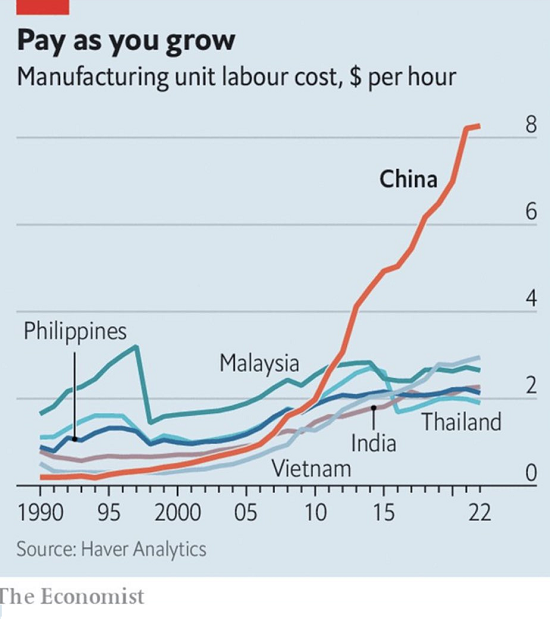
The pool of cheap, abundant Chinese labor has been completely drained. Wages in China have soared, along with inflation, and demographics is shrinking the labor pool even as the high expectations generated by 30 years of rapid expansion have diminished the labor force's willingness to perform low-paid factory work far from home and family.


China's economy is now beset with the inevitable downside of the S-Curve. Pouring more new money into an economy that is inflating speculative bubbles with the money doesn't create productive uses for the new credit; it simply encourages the perverse incentives to speculate and skim.

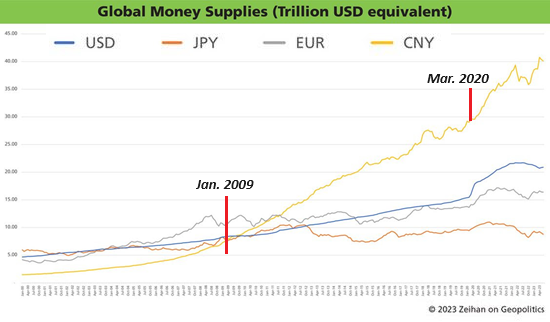
China is not alone in boosting its money supply and debt, but it is the current leader, whose gigantic expansion of credit bailed out the Chinese and global economy in 2009 and again in 2020. But that mechanism is now crippled by diminishing returns; inflating the money supply, borrowing trillions to fund deficit fiscal spending and expanding private credit to fund student loans, auto loans and bloated mortgages globally is no longer creating growth--it's creating inflation and the permanent drag of higher debt service.

If excesses pop a few of the planet's proliferating speculative asset bubbles, we'll discover that deflation in overvalued assets won't translate into lower-real-world inflation of goods and services, which depend on the costs of labor, capital and risk, all of which are rising in long-overdue turns of cycles.


Meanwhile, for a variety of well-known reasons, globalization as a source of deflation has run its course and is no longer able to offset inflation in either China or the nations importing Chinese goods globally. Wages in the US have been suppressed for 45 years in favor of capital and financiers, and now the pendulum is swinging to higher wages for demographic, financial and political reasons.

Reshoring, friend-shoring, building redundant supply chains, securing national-security sources of minerals and energy--every one of these costs far more than the supply chains being replaced, not just initially, but into the future.


With China as a global deflator now a spent force, inflation will not drop to 2% and linger there indefinitely. All the currency and credit flooding into the global economy while production, quality and quantity all stagnate or collapse will fuel inflation.

All those counting on AI to magically boost productivity globally on a scale large enough to counter the tsunami of new currency and credit being issued to "bring demand forward" will be disappointed. When consumers run out of credit, the profit spigot dries up, AI or no AI. When higher debt payments suck companies and government entities dry, adding more currency and debt isn't a solution, it becomes the problem.

Where is the global deflator expansive enough to replace China's one-off deflation of global inflationary forces? There isn't one, and those counting on AI are forgetting that right now AI is a bottomless sinkhole of corporate spending, as CEOs are just as motivated by fads and the crowd as any clueless consumer. Most of the billions being dumped into AI projects will return nothing in the way of higher productivity or profits because AI is already a commodity.

Sure, inflation may well drop for a time as consumers rein in spending, but the "solution"--the accelerating issuance of more currency and debt--will only fuel inflation. The decades-long swing of the deflationary zero-interest rate pendulum has ended, and the swing to higher interest rates and higher inflation will only gather momentum in the decade ahead.


My new book is now available at a 10% discount ($8.95 ebook, $18 print): Self-Reliance in the 21st Century.

Read the first chapter for free (PDF)

Read excerpts of all three chapters

Podcast with Richard Bonugli: Self Reliance in the 21st Century (43 min)


My recent books:

Disclosure: As an Amazon Associate I earn from qualifying purchases originated via links to Amazon products on this site.

The Asian Heroine Who Seduced Me (Novel) print $10.95, Kindle $6.95 Read an excerpt for free (PDF)

When You Can't Go On: Burnout, Reckoning and Renewal $18 print, $8.95 Kindle ebook; audiobook Read the first section for free (PDF)

Global Crisis, National Renewal: A (Revolutionary) Grand Strategy for the United States (Kindle $9.95, print $24, audiobook) Read Chapter One for free (PDF).

A Hacker's Teleology: Sharing the Wealth of Our Shrinking Planet (Kindle $8.95, print $20, audiobook $17.46) Read the first section for free (PDF).

Will You Be Richer or Poorer?: Profit, Power, and AI in a Traumatized World
(Kindle $5, print $10, audiobook) Read the first section for free (PDF).

The Adventures of the Consulting Philosopher: The Disappearance of Drake (Novel) $4.95 Kindle, $10.95 print); read the first chapters for free (PDF)

Money and Work Unchained $6.95 Kindle, $15 print)
Read the first section for free


Become a $1/month patron of my work via patreon.com.

Subscribe to my Substack for free


NOTE: Contributions/subscriptions are acknowledged in the order received. Your name and email remain confidential and will not be given to any other individual, company or agency.

Thank you, David K. ($300), for your beyond-outrageously generous contribution to this site -- I am greatly honored by your steadfast support and readership.


Thank you, Bindu M. ($50), for your marvelously generous contribution to this site -- I am greatly honored by your steadfast support and readership.


Thank you, Richard H. ($50), for your superbly generous contribution to this site -- I am greatly honored by your steadfast support and readership.


Thank you, Guy T. ($50), for your magnificently generous contribution to this site -- I am greatly honored by your steadfast support and readership.

Read more...

Monday, January 08, 2024

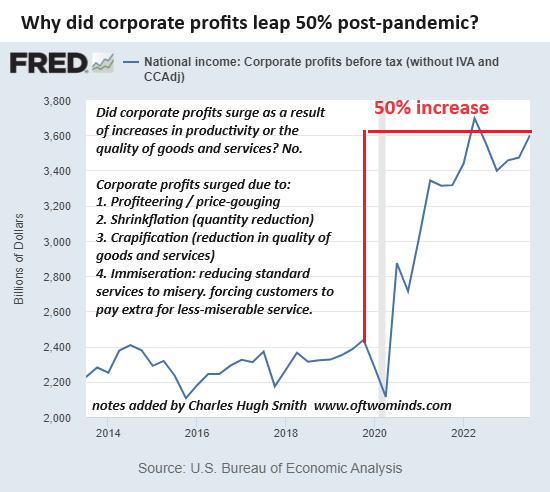
What's the Source of the Astounding 50% Boost in Corporate Profits?

No wonder Corporate America added $1.2 trillion in profits to be distributed to the elites of America: everything is diminished, stripped of quality and rendered miserable. Too bad there's no real competition left in the US economy.

One of the most extraordinary economic marvels of the past decade is the astounding 50% leap in corporate profits, from $2.4 trillion (pre-tax) pre-pandemic lockdown to $3.6 trillion (pre-tax) in the years since the lockdown ended.

Strangely, few seem to ask the source of this astounding 50% leap. Wall Street has certainly cheered this vast increase, but few analysts ponder the source, or ask if the source is a net plus for the economy and nation.

As shockingly heretical as it sounds, the interests of corporate America often diverge from the interests of the citizenry, overall economy and the nation. For example, the wholesale gutting of the US industrial base in the mad rush to lower costs and quality by shipping entire supply chains to China.

As I've often pointed out, the meagre savings that trickled down to the consumer were more than offset by the collapse of quality and durability in the globalized goods that now line the shelves of every retailer in the US.

Corporate PR and its well-paid army of toady analysts and pundits would have us believe this is "capitalism" busily at work as pent-up consumer demand naturally pushed prices higher, and corporations were--sadly--forced to pass along these higher costs to consumers.

Recall that "higher costs" don't show up as higher profits. If the "cost of goods" is $1, and I charge the consumer $2, I reap $1 profit. If my costs double to $2 and I charge the consumer $3, I reap the same $1 profit as I did before the cost spike pushed my production costs up.

The higher corporate profits are the direct result of profiteering and price-gouging. Oh boo-hoo, our costs went up and we were forced to pass them along was simply the cover story. If the cost of a $1 item went up $1 to $2, Corporate America merrily doubled its profit margin from $1 to $2.

This is what happens when you allow your economy to be dominated by quasi-monopolies and cartels. They all raise prices and diminish quality as a unified concentration of financial and political power.

The other source of sharply higher corporate profits is shrinkflation, the relentless reduction in the quantity of product in the packaging. One wonders how thin the can of tuna will eventually be--the thickness of a pancake? Or how thin can they make the box of cereal before the container can no longer stand upright?

The reduction of the quality of goods and services, a.k.a. crapification, is a key source of soaring corporate profits. As the unhappy buyer of three replacement appliances this year alone, all replacements for failed name-brand appliances that lasted 7 years or less--I can attest that crapification / planned obsolescence is a core source of higher profits.

Design the product to fail, or default to the lowest cost components, i.e. failure by default, and consumers are forced to replace appliances every few years that once routinely lasted decades. This conveyor belt of products to the Landfill is highly profitable.

Lastly, there's the immiseration of services, making standard service so miserable that consumers are forced to either endure wretched, incompetent, unreliable service, or pay extra for a "premium" service which is actually of poorer quality than the old standard of service.

We're adding adverts to all the films and TV programs you're already paying for. If you want to watch ad-free content, that will now cost you another $2.99 a month.

As Darth Vader would summarize this immiseration: "Pray I don't alter the deal any further." No wonder Corporate America added $1.2 trillion in profits to be distributed to the elites of America: everything is diminished, stripped of quality and rendered miserable. Too bad there's no real competition left in the US economy.


My new book is now available at a 10% discount ($8.95 ebook, $18 print): Self-Reliance in the 21st Century.

Read the first chapter for free (PDF)

Read excerpts of all three chapters

Podcast with Richard Bonugli: Self Reliance in the 21st Century (43 min)


My recent books:

Disclosure: As an Amazon Associate I earn from qualifying purchases originated via links to Amazon products on this site.

The Asian Heroine Who Seduced Me (Novel) print $10.95, Kindle $6.95 Read an excerpt for free (PDF)

When You Can't Go On: Burnout, Reckoning and Renewal $18 print, $8.95 Kindle ebook; audiobook Read the first section for free (PDF)

Global Crisis, National Renewal: A (Revolutionary) Grand Strategy for the United States (Kindle $9.95, print $24, audiobook) Read Chapter One for free (PDF).

A Hacker's Teleology: Sharing the Wealth of Our Shrinking Planet (Kindle $8.95, print $20, audiobook $17.46) Read the first section for free (PDF).

Will You Be Richer or Poorer?: Profit, Power, and AI in a Traumatized World
(Kindle $5, print $10, audiobook) Read the first section for free (PDF).

The Adventures of the Consulting Philosopher: The Disappearance of Drake (Novel) $4.95 Kindle, $10.95 print); read the first chapters for free (PDF)

Money and Work Unchained $6.95 Kindle, $15 print)
Read the first section for free


Become a $1/month patron of my work via patreon.com.

Subscribe to my Substack for free


NOTE: Contributions/subscriptions are acknowledged in the order received. Your name and email remain confidential and will not be given to any other individual, company or agency.

Thank you, Les M. ($350), for your beyond-outrageously generous contribution to this site -- I am greatly honored by your steadfast support and readership.


Thank you, Larry M. ($100), for your outrageously generous contribution to this site -- I am greatly honored by your steadfast support and readership.


Thank you, Dody M. ($10.80), for your superbly generous subscription to this site -- I am greatly honored by your steadfast support and readership.


Thank you, Monkeys Barking ($1/month), for your most generous subscription to this site -- I am greatly honored by your support and readership.

Read more...

Thursday, January 04, 2024

What the Fed Accomplished: Distorted the Economy, Enriched the Rich and Crushed the Middle Class

The mainstream holds the Fed is busy planning a return to the glory days of zero interest rates, but ZIRP is on the downside of the S-Curve; it's done, gone, history.

Let's summarize what the Federal Reserve accomplished since embarking on its massive interventions to control volatility, risk, bond yields, interest rates, the mortgage market, bank subsidies and liquidity, all of which can be summed up as the cost of credit-capital, that is, capital that is borrowed into existence based on some form of collateral or income stream.

By artificially suppressing the cost of capital to less than inflation, the Fed succeeded in:

1. Fatally distorting the economy.

2. Greatly enriching the already-rich at the expense of the bottom 90%.

3. Crushing the middle class and reducing the bottom 90% to debt-serfs.

Let's consider how the Fed fatally distorted the economy by suppressing the cost of capital to less than inflation. Recall that the Fed crammed ZIRP--zero interest rate policy--down the throat of the economy from 2009 to 2020, while official inflation ate up 22% of the purchasing power of the dollar. Inflation was never 0%, so the cost of capital for corporations and financiers was actually negative, i.e. less than inflation.

Reducing the cost of capital had multiple distorting effects. A useful analogy is the critical role of "keystone species" in maintaining healthy, diverse ecosystems.

Risk and competition are the vital forces enabling a diverse ecosystem. Once the keystone predators have been eliminated (starfish, wolves, et al), the species freed from risk and competition overwhelm the ecosystem and crowd out healthy diversity. These species end up destroying the ecosystem via overgrazing, destruction of forests, etc.

The same dynamic, enforced by the Fed, has gutted the US economy. Corporations and financiers with virtually unlimited access to near-zero cost capital were freed to buy up hundreds of smaller competitors, buy back trillions of dollars of their own shares to enrich the already rich managers and large shareholders and leverage their assets and cash flow into Empires of Debt which could be sold or taken public (WeWork, et al) reaping enormous profits--profits unavailable to wage earners and those who did not have the opportunity to acquire assets before ZIRP inflated the Everything Bubble.

It's been estimated that the majority of the S&P 500 / stock market's rise from 667 in 2009 to current levels around 4,700 was solely the result of corporate buybacks that reduced the number of shares. This artificially increased the revenues and earnings per share. (Buybacks were once illegal, for good reason.)

All these trillions in near-zero cost capital flowed into manipulation, speculation and the reduction of competition, not into boosting productivity, efficiency or innovation. The net result of the Fed's ZIRP is an economy stripped of diversity, an economy dominated by bloated monopolies, cartels and platforms generating low-quality, addictive goods and services which reduce productivity on multiple fronts.

Lowering the cost of capital to near-zero also changed the incentives of corporate and banking leaders. The enormous profits flowed not from developing higher quality goods and services or improving customer service; they flowed from manipulating markets with near-zero cost capital, borrowing fortunes against corporate commercial real estate and distributing the gains to shareholders and managers.

Near-zero cost capital rewarded speculators and CEOs who leveraged financier plays, not those investing for the long-term in America. The Fed's distortions are fatal because they stripped the economy of incentives that are positive for the nation, not just for corporations and the already-wealthy.

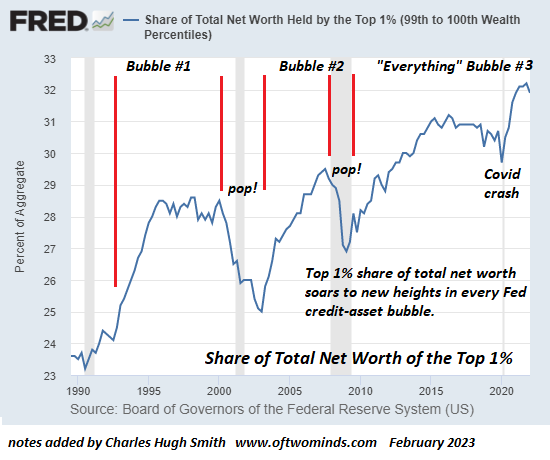
Lowering the cost of capital to zero also distorted the balance between labor and capital in favor of capital, as the already-wealthy, i.e. those who already owned collateral and cash flows, could leverage up their assets and income to borrow vast sums at near-zero interest to scoop up income-producing assets. Mere wage earners could not compete and so wealth and income flowed to the top 01%, top 1% and top 10%:


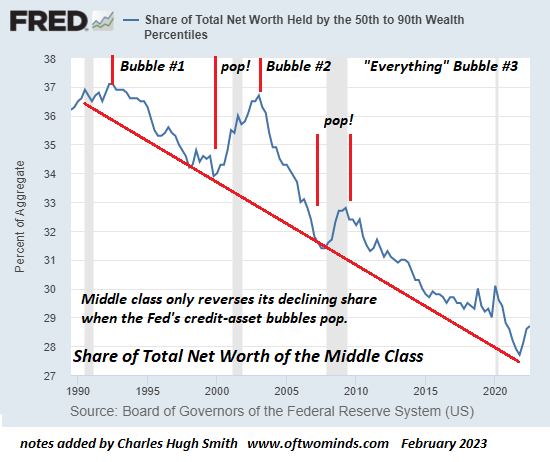
This concentration of wealth and income came at the expense of the middle class, whose share of the nation's wealth plummeted:


Suppressing the cost of capital also incentivized over-borrowing / the runaway expansion of debt as interest payments are so cheap, why not borrow as much as possible and invest the money in higher returns and "shovel-ready" government projects?

This fueled global carry trades and the runaway expansion of both government and private-sector debt, debt loads which are increasingly crushing as interest rates slowly return to historic norms. In effect, we've borrowed $3.50 to eke out $1 in GDP expansion--$3.50 that will accrue interest until it is paid off, something that never happens in government debt and rarely happens in corporate / commercial real estate debt. Rather than being paid off, debt is simply rolled over into new debt.


The Fed's cover stories were bringing demand forward and goosing the wealth effect: lowering interest rates to near-zero encouraged enterprises, agencies and households to borrow and spend money now rather than in the future, and dropping interest rates inflated asset bubbles, making the already-rich feel even richer, on the theory that this emotional response would generate more borrowing and spending.

The fatal flaws in these policies are becoming apparent. Bringing demand forward eventually soaks up all available income, over-leverages assets such as commercial real estate, and increases inflation as limitless capital chases limited goods and materials.

As for the wealth effect, only the top 10% who own 90% of all assets and reap 50% of all income felt the wealth effect. Everyone else simply dug themselves a deeper hole of debt to service, what's known as debt serfdom.

The mainstream holds the Fed is busy planning a return to the glory days of zero interest rates, but ZIRP is on the downside of the S-Curve; it's done, gone, history. Higher rates are built into an economy that was stripped of risk, competition and diversity by the Fed's fatal distortions.


My new book is now available at a 10% discount ($8.95 ebook, $18 print): Self-Reliance in the 21st Century.

Read the first chapter for free (PDF)

Read excerpts of all three chapters

Podcast with Richard Bonugli: Self Reliance in the 21st Century (43 min)


My recent books:

Disclosure: As an Amazon Associate I earn from qualifying purchases originated via links to Amazon products on this site.

The Asian Heroine Who Seduced Me (Novel) print $10.95, Kindle $6.95 Read an excerpt for free (PDF)

When You Can't Go On: Burnout, Reckoning and Renewal $18 print, $8.95 Kindle ebook; audiobook Read the first section for free (PDF)

Global Crisis, National Renewal: A (Revolutionary) Grand Strategy for the United States (Kindle $9.95, print $24, audiobook) Read Chapter One for free (PDF).

A Hacker's Teleology: Sharing the Wealth of Our Shrinking Planet (Kindle $8.95, print $20, audiobook $17.46) Read the first section for free (PDF).

Will You Be Richer or Poorer?: Profit, Power, and AI in a Traumatized World
(Kindle $5, print $10, audiobook) Read the first section for free (PDF).

The Adventures of the Consulting Philosopher: The Disappearance of Drake (Novel) $4.95 Kindle, $10.95 print); read the first chapters for free (PDF)

Money and Work Unchained $6.95 Kindle, $15 print)
Read the first section for free


Become a $1/month patron of my work via patreon.com.

Subscribe to my Substack for free


NOTE: Contributions/subscriptions are acknowledged in the order received. Your name and email remain confidential and will not be given to any other individual, company or agency.

Thank you, David S. ($200), for your beyond-outrageously generous contribution to this site -- I am greatly honored by your steadfast support and readership.


Thank you, Michael and Wendy A.D. ($50), for your supremely generous contribution to this site -- I am greatly honored by your steadfast support and readership.


Thank you, Tom C. ($5/month), for your superbly generous subscription to this site -- I am greatly honored by your steadfast support and readership.


Thank you, Harley O. ($10/month), for your fantastically generous subscription to this site -- I am greatly honored by your steadfast support and readership.

Read more...

Monday, January 01, 2024

2023: The Fed Declares Victory; 2024: The Year of Hubris and Nemesis

Are the crowds ready for the curtain of Fed omnipotence to be pulled aside? What will push markets ever higher if the Fed's alchemy fails?

For 15 long years, the Federal Reserve has conjured an economy and financial system without crisis or lengthy recession (setting aside that spot of bother triggered by the pandemic shutdown as a "bolt from the blue"), all with god-like mastery of the financial dials of bond yields, interest rates, vast purchases of mortgages, the subsidizing of the banking sector and the enlivening floods of liquidity that have elevated markets to extraordinary heights.

It is thus understandable that Fed Chair Powell declared victory in December 2023, having engineered the tricky maneuver known as "the soft landing" without crushing employment, spending, credit or markets.

We can easily imagine a triumphant parade of the Fed's leaders, each lauded as demi-gods of the financial realm. We can also sense the palpable confidence of the crowd, so greatly enriched by the Fed's mastery, that the Fed's mastery will continue unabated for another 15 years--in other words, essentially forever.

That was 2023. In 2024, things might turn out differently than the crowd expects, not because of the oft-dreaded Fed policy error but for reasons beyond the reach of financial machinations.

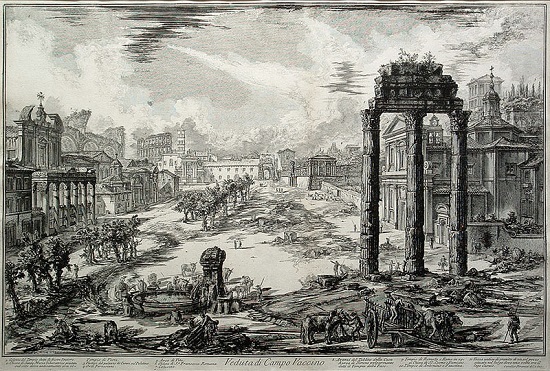
I speak of Hubris and Nemesis, not wonky policy errors. In the glory years of the Roman Empire, triumphant parades celebrating victorious generals were said to feature a charioteer who followed the general, whispering (or perhaps shouting over the cacophony of the crowds) Respice post te! Hominem te memento!: "Look behind you! Remember you are only a man!"

In other tellings, it is a slave who is ordered to shadow the victorious leader, whispering Memento Mori, "Remember, thou art mortal."

The point of the story is that hubris--excessive pride and confidence in one's power and victories, excesses that breed complacency--offends the gods, especially the goddess Nemesis, the "dispenser of dues," who relishes delivering retribution on the prideful for their undeserved good fortune.

In other words, 15 years of victories and glory has undoubtedly attracted the scornful attention of Nemesis. How Nemesis might exact her dues is of course unknown, but we can anticipate that the sources of excessive pride and confidence in one's power will fail the Fed in unexpected ways: perhaps the Fed will fiddle with the dials in the same fashion that yielded one victory after another, only this time the results will be chaos rather than calm and defeat rather than victory.

The entire field of economics is ripe for a rebalancing visit from Nemesis to dissipate the illusion of god-like powers bestowed by financial alchemy. We have been lulled by the declarations of victory into believing that all that's needed for permanent prosperity is the right mix of top-down financial policies: a subsidy here, a tax break there, all floated by a tsunami of Fed liquidity--the unequaled magic holding the entire financial Empire together.


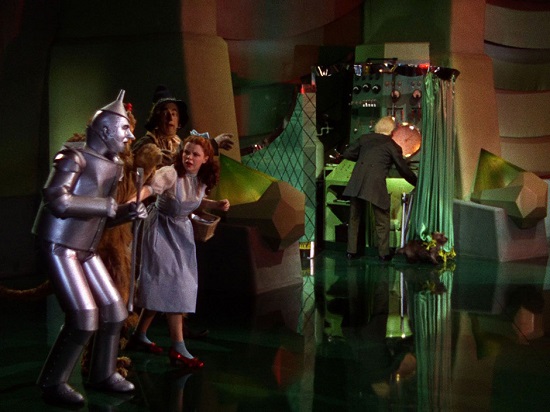
Are the crowds ready for the curtain of Fed omnipotence to be pulled aside? What will push markets ever higher if the Fed's alchemy fails? All that gold created out of base metals by the Fed might be revealed as nothing more than a paper-thin coating of gold over bars of lead.

In our hubris, we reckon the alchemy of finance gives us god-like powers. That's the ideal setup for a takedown by Nemesis.


My new book is now available at a 10% discount ($8.95 ebook, $18 print): Self-Reliance in the 21st Century.

Read the first chapter for free (PDF)

Read excerpts of all three chapters

Podcast with Richard Bonugli: Self Reliance in the 21st Century (43 min)


My recent books:

Disclosure: As an Amazon Associate I earn from qualifying purchases originated via links to Amazon products on this site.

The Asian Heroine Who Seduced Me (Novel) print $10.95, Kindle $6.95 Read an excerpt for free (PDF)

When You Can't Go On: Burnout, Reckoning and Renewal $18 print, $8.95 Kindle ebook; audiobook Read the first section for free (PDF)

Global Crisis, National Renewal: A (Revolutionary) Grand Strategy for the United States (Kindle $9.95, print $24, audiobook) Read Chapter One for free (PDF).

A Hacker's Teleology: Sharing the Wealth of Our Shrinking Planet (Kindle $8.95, print $20, audiobook $17.46) Read the first section for free (PDF).

Will You Be Richer or Poorer?: Profit, Power, and AI in a Traumatized World
(Kindle $5, print $10, audiobook) Read the first section for free (PDF).

The Adventures of the Consulting Philosopher: The Disappearance of Drake (Novel) $4.95 Kindle, $10.95 print); read the first chapters for free (PDF)

Money and Work Unchained $6.95 Kindle, $15 print)
Read the first section for free


Become a $1/month patron of my work via patreon.com.

Subscribe to my Substack for free


NOTE: Contributions/subscriptions are acknowledged in the order received. Your name and email remain confidential and will not be given to any other individual, company or agency.

Thank you, Jose S. ($200), for your beyond-outrageously generous contribution to this site -- I am greatly honored by your steadfast support and readership.


Thank you, Mark S.C. ($50), for your monstrously generous contribution to this site -- I am greatly honored by your steadfast support and readership.


Thank you, Colin G. ($50), for your fantastically generous contribution to this site -- I am greatly honored by your steadfast support and readership.


Thank you, Duane S. ($25), for your superbly generous contribution to this site -- I am greatly honored by your steadfast support and readership.

Read more...

Terms of Service

All content on this blog is provided by Trewe LLC for informational purposes only. The owner of this blog makes no representations as to the accuracy or completeness of any information on this site or found by following any link on this site. The owner will not be liable for any errors or omissions in this information nor for the availability of this information. The owner will not be liable for any losses, injuries, or damages from the display or use of this information. These terms and conditions of use are subject to change at anytime and without notice.


Our Privacy Policy:


Correspondents' email is strictly confidential. This site does not collect digital data from visitors or distribute cookies. Advertisements served by a third-party advertising network (Investing Channel) may use cookies or collect information from visitors for the purpose of Interest-Based Advertising; if you wish to opt out of Interest-Based Advertising, please go to Opt out of interest-based advertising (The Network Advertising Initiative). If you have other privacy concerns relating to advertisements, please contact advertisers directly. Websites and blog links on the site's blog roll are posted at my discretion.


PRIVACY NOTICE FOR EEA INDIVIDUALS


This section covers disclosures on the General Data Protection Regulation (GDPR) for users residing within EEA only. GDPR replaces the existing Directive 95/46/ec, and aims at harmonizing data protection laws in the EU that are fit for purpose in the digital age. The primary objective of the GDPR is to give citizens back control of their personal data. Please follow the link below to access InvestingChannel’s General Data Protection Notice. https://stg.media.investingchannel.com/gdpr-notice/


Notice of Compliance with The California Consumer Protection Act
This site does not collect digital data from visitors or distribute cookies. Advertisements served by a third-party advertising network (Investing Channel) may use cookies or collect information from visitors for the purpose of Interest-Based Advertising. If you do not want any personal information that may be collected by third-party advertising to be sold, please follow the instructions on this page: Limit the Use of My Sensitive Personal Information.


Regarding Cookies:


This site does not collect digital data from visitors or distribute cookies. Advertisements served by third-party advertising networks such as Investing Channel may use cookies or collect information from visitors for the purpose of Interest-Based Advertising; if you wish to opt out of Interest-Based Advertising, please go to Opt out of interest-based advertising (The Network Advertising Initiative) If you have other privacy concerns relating to advertisements, please contact advertisers directly.


Our Commission Policy:

As an Amazon Associate I earn from qualifying purchases. I also earn a commission on purchases of precious metals via BullionVault. I receive no fees or compensation for any other non-advertising links or content posted on my site.

  © Blogger templates Newspaper III by Ourblogtemplates.com 2008

Back to TOP