








Is AI Reversing Anti-Progress or Is It Accelerating It?
Perhaps it's time to admit that AI hype is self-serving propaganda, and that we're actually living in a Philip K. Dick-type dystopia.
Consider the depth and consequences of the widening gap between these headlines. One the one hand, we're awash in articles proclaiming the immense value being generated by AI and the promise of future value that's beyond our imagination. But if we set aside the sci-fi promises of AI discovering miracle drugs that cure every disease and focus on what AI is actually being used for, it boils down to 1) increasing corporate revenues and 2) increasing corporate profits by reducing costs.
That's it. There is nothing else except clickbait headlines intended to create a PR-propaganda illusion that fantastic advances are just around the corner, just you wait.
But in the real world, AI is solely focused on increasing corporate profits via streamlining workflows and increasing productivity. There are hundreds of headlines along these lines: How AI is reshaping workflows and redefining jobs (mitsloan.mit.edu)
Here's the short version: Corporations are in a frenzy to use AI to jack up revenues via extraction rather than creating value, and boosting profits by slashing payrolls and costs. This is evident in headlines such as this:
Why are US consumers so angry? It's not just high prices. (theguardian.com)
First, her longtime vet, now part of a national chain, overcharged her $500 for her dog's teeth cleaning and didn't issue a promised refund. Then, her big box supermarket promoted a coupon on its app that wasn't applied at the checkout, costing her $30 and a trip back to the store. Finally, her health insurance company rejected her son's $1100 dental bill that she had been told would be 50% covered, despite protracted haggling.
"It's like Whac-A-Mole," the mother of two said. "You finish one and up pops another one."
"It feels like a war on consumers," said Sally Greenberg, the executive director of the National Consumers League, a 125-year-old consumer advocacy group. "Households are being hit by "a tsunami of fees and hidden charges and tricks and traps," she said.
Peter Fader, a Wharton School marketing professor, said, "But not only does service just suck, consumers are starting to realize that a lot of the cool data and technology is being used against them."
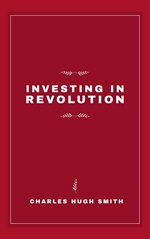
This isn't the FantasyLand story of corporations "creating value," it's the ugly real-world story of corporations increasing profits by controlling markets to extract more revenues while reducing value. In my book Investing In Revolution I explain that once companies eliminate real competition via monopoly, cartels or regulatory capture (deceptively called "market forces"), they become privatized totalitarian structures that corral consumers so they can be exploited to maximize extraction / profits without pushback from either the consumers or a controlled-by-the-highest-bidder state that enables privatized totalitarianism because a trickle of the trillions in profits flows to state insiders.
The ceaseless reduction of value and the expansion of data collection technologies to maximize extractive profiteering has a name: Anti-Progress, for declining quality and value coupled with higher costs and reduced alternatives (i.e. real competition) is not Progress, though it's ceaselessly touted as "Progress" by the corporations feasting on Anti-Progress to maximize profits by any means available.
Streamlining workflows and increasing productivity are not devoted to improving the quality of life of the populace or benefiting the shared interests of society; the single-minded goal is using AI to maximize profits via extraction. The difference between a totalitarian state (no competition) and totalitarian monopolies and cartels (no competition) is, well, the difference between privatized extraction and state extraction.
In the US, we have the worst of both worlds: an extractive state that funds and enables extractive privately owned corporations. Ask yourself an honest question--yes, that's difficult in a system that incentivizes artifice and self-serving deception: what exactly has AI done to improve real-world life in terms of quality and cost?
Even what's touted turns out to be extractive, distorting Anti-Progress. That AI is now our new best friend is not Progress, and neither is the core impossibility of trusting AI "answers" to be useful.
The core problem isn't just the illusion of "Progress" used to cover exploitive extraction; it's that AI is deceptive by its very nature, as it implicitly presents a probability distribution as fact, truth, judgment, thinking and understanding, when it cannot possibly be any of these.
This article explains this clearly and succinctly:
AI and human intelligence are drastically different--here's how. (scientificamerican.com)
The deeper issue is that the model cannot know when it is "hallucinating" because it cannot represent truth in the first place. It cannot form beliefs, revise them or check its output against the world. It cannot distinguish a reliable claim from an unreliable one except by analogy to prior linguistic patterns. In short, it cannot do what judgment is fundamentally for.
People are already using these systems in contexts in which it is necessary to distinguish between plausibility and truth, such as law, medicine and psychology. A model can generate a paragraph that sounds like a diagnosis, a legal analysis or a moral argument. But sound is not substance. The simulation is not the thing simulated.
They are engines of linguistic automation, not engines of understanding. They excel at drafting, summarizing, recombining and exploring ideas. But when we ask them to judge, we unintentionally redefine judgment--shifting it from a relation between a mind and the world to one between a prompt and a probability distribution.
Remember that smoothness is not insight, and eloquence is not evidence of understanding.
Here's a short list of the many examples of AI generating Anti-Progress on multiple fronts, including but not limited to extractive exploitation:
In the USA, the level of vigilance the average person has to maintain to avoid getting ripped off extracts its own kind of price -- one most analysis of dynamic pricing doesn't pay any attention to. (Tim Wu)
I think the Boomer/Gen Z discourse boils down to one thing and one thing alone:
The America that Boomers grew up in put American families and American workers first.
The America that Gen Z is growing up in puts literally everything else first.
We need a new regulatory paradigm to contain AI and prevent institutional collapse. A quick explanation.
The Record Divide Between Corporate Profits and Worker Pay:
Labor's share of economic output just hit an all-time low, while the profit share hit a near record. It helps explain why consumers feel so glum. (wsj.com)
'It's never enough': young Americans struggle to build financial independence as cost of living spikes/ A difficult job market and rising costs are making it harder for young adults to enter adulthood.
Lastly, consider this question:
How can we tell good AI from bad? (ft.com)
Short answer: we can't, and the gap between being able to ascertain the good from the bad is widening at an accelerating pace.
This is what we've been seeing with every company we work with. Try justifying spending 100k on token spend when only 18k even makes it to a stable product feature. Very interesting data across 2,444 companies. 82% of tokens are spent on AI-generated bugs, rework and review friction.
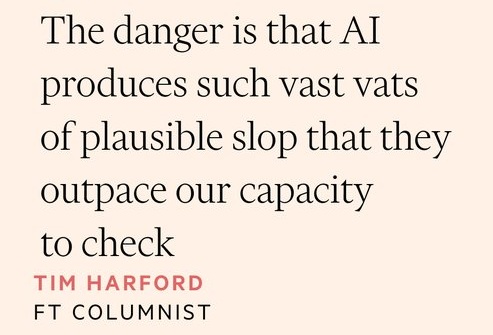
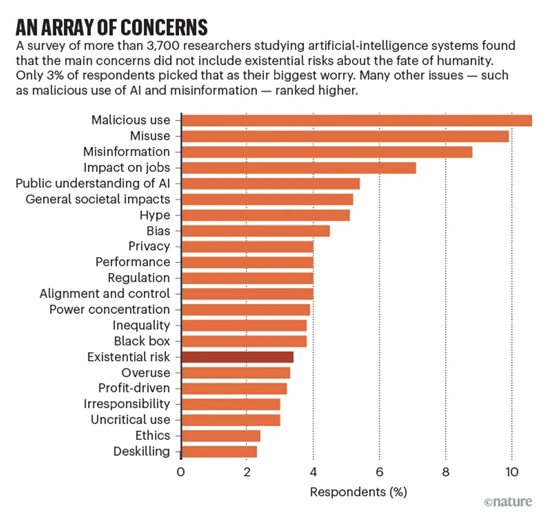
Please note what's missing from this list of AI concerns: "AI is improving my quality of life, reducing complexity and costs, and eliminating AI slop and extractive corporate exploitation at such a dizzying pace I wish it would slow down the vast improvements in my life so I can catch my breath."
 Is AI Reversing Anti-Progress or Is It Accelerating It? The answer is it's accelerating Anti-Progress in every nook and cranny of the economy, society and culture. Perhaps it's time to admit that AI hype is self-serving propaganda, and that we're actually living in a Philip K. Dick-type dystopia in which we're constantly told AI will cure the diseases it's creating at some point in the future, while it generates more diseases at an ever-accelerating pace.
My book Investing In Revolution is available at a 10% discount ($18 for the paperback, $24 for the hardcover and $8.95 for the ebook edition).
Introduction (free)
Become
a $3/month patron of my work via patreon.com
Subscribe to my Substack for free
NOTE: Contributions/subscriptions are acknowledged in the order received. Your name and email remain confidential and will not be given to any other individual, company or agency.
|
Thank you, David M. ($75), for your marvelously generous subscription to this site -- I am greatly honored by your support and readership. |
Thank you, Julie W. ($3/month), for your wondrously generous subscription to this site -- I am greatly honored by your support and readership. |
|