

The Lit Fuse: Low Interest Rates Ruined the Economy
What matters is seeing the fuse burning and realizing it's going to blow up, and planning accordingly.
Perhaps the greatest irony of the inevitability of the stagflationary, bubble-popping recession we're entering is that the "solution" to the 2008-09 financial crisis--near-zero interest rates, limitless credit for the Too Big to Fail players, and the informal institutionalization of the Fed will always rescue the stock market Put--ruined the economy in ways few seem to recognize.
This ruination is systemic and structural, as it:
1. shifted the incentives from risk-sensitive investing to risk-insensitive speculation, rewarding gamblers loading up on high risk bets based on their confidence that the Federal Reserve will always intervene to reverse any stock market decline.
2. Made economic "growth" dependent on an ever-rising phantom wealth stock market rather than organic growth fueled by investing in increasing productivity that generates real value via higher quality goods and services.
3. Handed the biggest financial players--corporations, investment banks and financiers--the enormous advantages of lower borrowing costs and unlimited credit lines, advantages unavailable to households and small businesses. These credit-based advantages widened wealth and income inequality to extremes unseen since the Gilded Age.
4. Corporations with low-cost unlimited credit lines can always outbid households for homes, exacerbating the "housing shortage" which isn't actually a shortage, it's an artifact of low-cost unlimited credit lines for the biggest players, enabling them to monetize the family home as rentals, creating an artificial scarcity that then drove home prices to absurd heights.
5. Made financial-credit gaming far more profitable than actually producing goods domestically. Artificially low interest rates incentivize borrowing not to invest in the long-term but to place short-term speculative bets: get in, scalp a profit, exit. The "rational" response to artificially low interest rates is to offshore investment-heavy production and use cheap credit to snap up assets that can be monetized with credit-funded leverage for short-term gains without any of the risks of actually producing goods.
6. Low-cost credit in unlimited sums enabled corporations to snap up competitors, accelerating the collapse of competitive sectors into non-competitive monopolies and cartels that then gain the power to extract higher profits from captured consumers and immiserate our quality of life by reducing the quality of goods and services.
7. Made borrowing more money at artificially low costs the "solution" to everything, from the the nation-state to corporate to households. Rather than face painful, difficult tradeoffs of how to spend / invest scarce cash, the "solution" is now avoid all pain and tradeoffs by just borrowing more money because "it's now so cheap because interest rates are so low." You can have it all, just borrow more. And the "solution" when interest payments start crunching cash flow is--you guessed, it borrow more to pay the interest due on all the previous debt piled up.
8. Informally institutionalizes moral hazard, the artificial suspension of risk as the decisive factor in making financial decisions. The Fed Put basically turned the stock market and financial markets into casinos where losses are made whole, so why not borrow and gamble bigly?
This is easy and nice but it isn't "capitalism" nor is it sustainable. Whatever else it is, capitalism is a system of discipline and accountability in which capital (cash, assets) is put at risk to earn a gain.
If interest rates are artificially suppressed and risk is suspended (not evaporated, just transferred to another part of the system or a set of bagholders), then the essential causal connections between risk, cost of capital and return are sundered, freeing the borrower / gambler from the discipline and accountability that make "capitalism" a successful way to organize credit and production.
"Opportunity cost" is the calculation of what must be sacrificed / given up to put capital at risk in one venture of many potential ventures. Low-cost, unlimited credit distorts this calculation, since credit opens the door to no-tradeoffs-necessary "why not have it all?"
The elimination of discipline, tradeoffs, accountability and risk is the infantilization of the economy. We're like children at play, free of the burdens of adulthood, because Mommy and Daddy Fed will make it all better.
This is illusion, as discipline, tradeoffs, accountability and risk cannot be erased, they can only be transferred, and what the Fed's artificially suppressing interest rates has done is transfer risk to the entire financial system and US economy.
So while we're all happily playing pirates in the low-cost-credit sandbox, the financial system and economy are bursting at the seams with all the risks that have been stuffed in the basement, out of sight and out of mind.
In unfettered credit markets, lenders demand a substantial return for the risk of lending scarce and therefore valuable cash. In a ZIRP (zero-interest rate policy) / artificially suppressed interest rate economy, "Cash is trash" and low-cost credit favors the wealthiest, most influential players who can borrow at the lowest rates in virtually unlimited sums who can then outbid all but the other wealthiest few for income-producing assets.
This drives wealth-income inequality into overdrive, leading to distortions that have only one possible outcome: systemic imbalances that destabilize the entire socio-economic-political system, leading to crisis and collapse, which is where we are now.
Call this whatever you want, but it isn't Capitalism, it's a powder keg with a lit fuse. It's a rigged system of Cronyism in which those running the financial system favor the wealthiest and most powerful in every way, every day.
Those benefiting from this rigged-crony-ripoff are frantic to protect it behind a phony facade of "capitalism," so their armies of lackeys, factotums, toadies, sycophants and apologists instantly label policies President Dwight Eisenhower reckoned were self-evidently common-sense as "communist" or "socialist," i.e. evil, evil, evil.
Meanwhile, Adam Smith is rolling in his grave at the travesty of a mockery of a sham of the claim that this rigged-crony-ripoff system is "capitalist."
Let's look at some data / charts. Notice how wealth-income inequality soared from the 2009 inception of ZIRP / artificially suppressed interest rates. Go ahead and argue with the data, oops, sorry, the data won.

Here's the US Treasury 10-year bond yield. Cash is trash so let's go outbid hundreds of thousands of homeowners to snap up family homes as income-producing rentals.

Coincidence or causation? Labor's share of the economy took a nosedive from 2009 onward as capital earns a higher return being borrowed for gambling than it does from being invested in the workforce or production that actually improves our quality of life. What generates the highest profits is shipping production overseas and reducing the quality of goods and services, which is what we have today.

If you want to argue about something, argue about the length of fuse left before the powder keg blows up. Some claim we have decades of crony extraction and exploitation fun-and-games to go, while others see a fuse burning an inch from the powder keg. Whatever you "like" or "don't like" doesn't matter, it will blow up regardless.
What matters is seeing the fuse burning and realizing it's going to blow up, and planning accordingly.
 New collection of five intriguing stories: Jumble Bin Stories (Kindle $6, print $12) read samples for free (PDF)
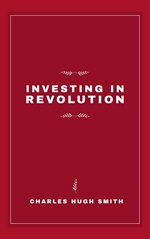
My book Investing In Revolution is available ($18 for the paperback, $24 for the hardcover and $8.95 for the ebook edition). Introduction (free)
Subscribe to my Substack for free
NOTE: Contributions/subscriptions are acknowledged in the order received. Your name and email remain confidential and will not be given to any other individual, company or agency.
|
Thank you, Eugene T. ($70), for your superbly generous subscription to this site -- I am greatly honored by your support and readership. |
Thank you, Richard ($70), for your marvelously generous subscription to this site -- I am greatly honored by your support and readership. |
|
|
Thank you, Uncle Fred ($70), for your massively generous subscription to this site -- I am greatly honored by your steadfast support and readership. |
Thank you, Francois-Guy D. ($70), for your splendidly generous subscription to this site -- I am greatly honored by your support and readership. |