Monday, March 30, 2026

The "Good News" Is Always the Same: the Stock Market Is Up--Until It Isn't

Cloaking a fake "market" with artifice to maintain its asymmetrical distribution of wealth and income also cloaks its detachment from the real world.

I often refer to the dynamics of self-correction and self-liquidation. Systems that use feedback to rebalance extremes are self-correcting: rather than accelerate as they approach a cliff, they slow down and reorganize to avoid runaway self-reinforcing feedback (i.e. positive feedback), a.k.a. run to failure.

Some things are self-liquidating by design. A mortgage, for example, is intended to be self-liquidating: the monthly payments reduce and eventually extinguish the debt.

Other systems become self-liquidating when artifice becomes the "solution" for those seeking to lock the system down to maintain their share of the spoils. This is the inevitable consequence when a culture veers into the black-hole spiral of moral decay, where integrity is dissolved by maximizing self-interest by any means available.

Responding to real-world feedback threatens to reduce insiders' share of the spoils, and to make sure this doesn't happen, insiders steer the system away from the real world, creating an artificial, synthetic representation of the system that relies not on real-world feedback but on signals and symbolism that can be engineered to serve the interests of those holding the levers of power and influence.

To those benefiting from a system, corrective feedback is anathema because it reduces their share of the spoils. The "solution" is various forms of artifice that maintain the illusion that the system is stable and responsive to the interests of all, when in fact it's been locked in a configuration that benefits the few at the expense of the many.

Self-serving artifice comes in many forms: the gaming of statistics to put lipstick on the real-world pig, the TACO Trade--announce some fabrication as a pending agreement with magical powers, virtue-signaling legislation that changes nothing in how the spoils are being distributed, grandiose claims of technological innovations--innovations that just happen to be owned by a handful of corporations--that will benefit everyone, and so on.

This substitution of artifice for authenticity relies heavily on signals and symbolism. Rather than attempt to manipulate all the complexities of the real-world economy, the stock market is now the signal for the entire economy: if stocks are going up, the economy is good.

This elevation of the stock market as the one true indicator rests on an entire universe of symbolic meanings and mythologies. The stock market is the invisible hand, the magic mechanism of price discovery, the engine of growth that rewards innovation and ingenuity while enriching us all with fabulous new technologies, the perpetual-motion device that makes America the greatest generator of prosperity in history, and so on.

Like all good cons, there is some truth buried beneath the hype. An unmanipulated market does indeed have the potential to reward innovation and ingenuity and generate widespread prosperity.

But the whole point of these mythologies is to cloak a manipulated market in the finery of an authentic market. This bewitchment is akin to the Emperor's New Clothes: a fabrication, a tale, that takes on a life of its own as a mass delusion.

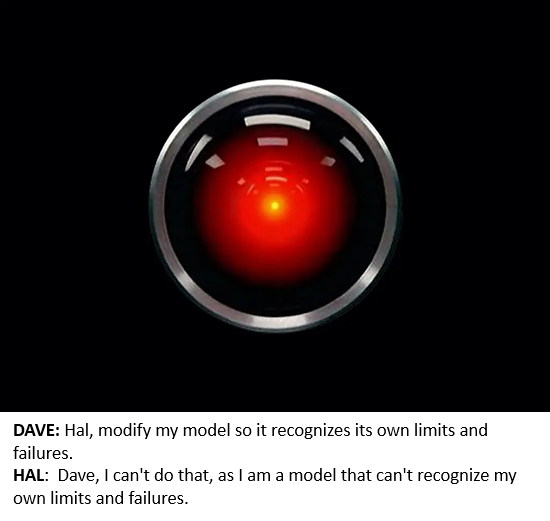
Cloaking a fake "market" with artifice to maintain its asymmetrical distribution of wealth and income also cloaks its detachment from the real world. This is how systems veer into Model Collapse and self-liquidation: the artificial representations, the reliance on easily faked signals and euphoria-inducing mythologies collapse once they collide with reality.

Which brings us to the present, where the stock market has become the economy, the driver of wealth and prosperity as the top 10% who own the majority of stocks can spend freely enough to employ the bottom 90% and pay the taxes needed to fund an out-of-control state sector that lavishes subsidies on every class to stave off a reckoning.

Here is reality: all credit-asset bubbles are inherently unstable and so they pop. While the timing isn't predictable, the collapse of what is intrinsically self-liquidating is entirely predictable.


Here is the Emperor's New Clothing version of mass delusion: the Everything Bubble is permanent and will never pop, and if it does, some agency with god-like powers will rush to the rescue.


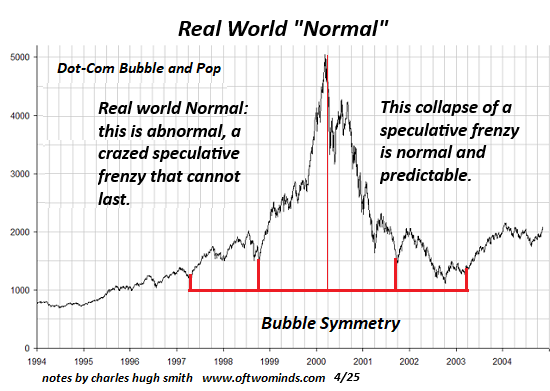
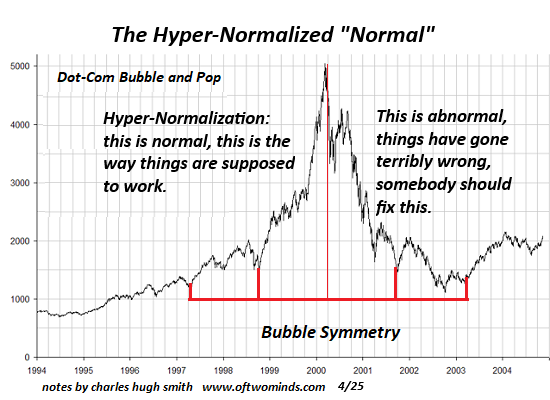
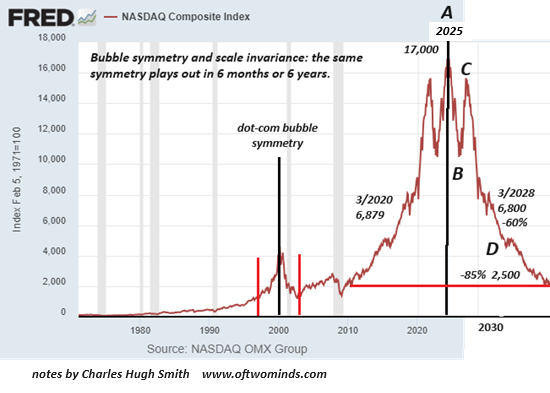
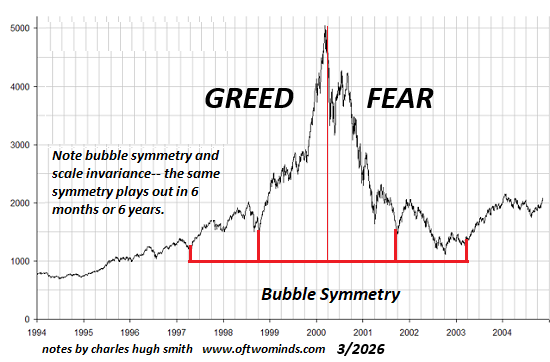
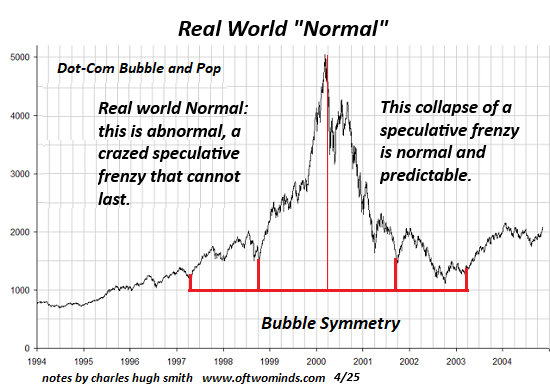
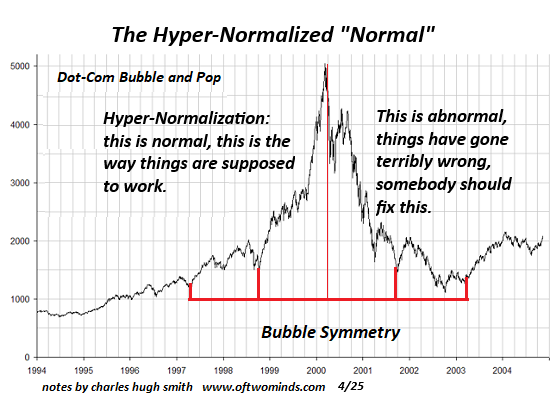
But self-liquidating systems are not permanent. Their internal dynamics guarantee the end-game is extinguishment. Here is a projection of the Everything Bubble based on bubble symmetry and scale invariance: what goes up will come down on a similar trajectory.


That the Emperor is buck-naked should not surprise us, but awakening from mass delusion is by its very nature a stunning surprise.


These dynamics are drawn from my Revolution Trilogy.


New Podcast: Self-Liquidating Systems, Parallel Worlds, and AI Doesn't Live In A Moral Universe (Leafbox)
Apple podcast


My book Investing In Revolution is available at a 10% discount ($18 for the paperback, $24 for the hardcover and $8.95 for the ebook edition). Introduction (free)


Check out my updated Books and Films.

Become a $3/month patron of my work via patreon.com

Subscribe to my Substack for free


NOTE: Contributions/subscriptions are acknowledged in the order received. Your name and email remain confidential and will not be given to any other individual, company or agency.

Thank you, Ben K. ($70), for your monumentally generous subscription to this site -- I am greatly honored by your support and readership.


Thank you, irving W. ($7/month), for your marvelously generous subscription to this site -- I am greatly honored by your support and readership.


Thank you, James A. ($70) for your superbly generous subscription to this site -- I am greatly honored by your support and readership.


Thank you, MChips ($70) for your splendidly generous subscription to this site -- I am greatly honored by your support and readership.

Read more...

Friday, March 27, 2026

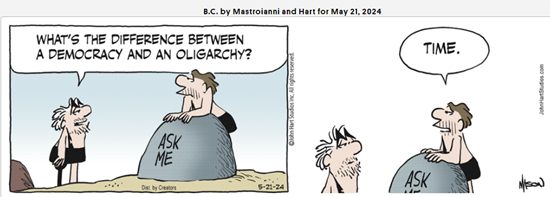
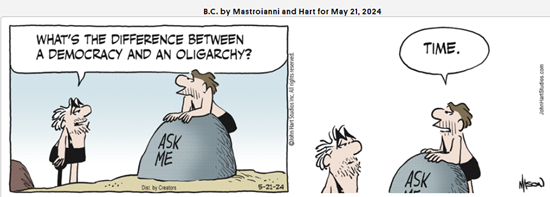
Is a "Democracy" That's For Sale Still a Democracy? No, It's an Oligarchy

To claim that jostling for the biggest share of federal power and largesse--in a word, greed--magically serves the common good is a convenient cover for an oligarchy masquerading as a "democracy."

Is a "democracy" that's for sale still a democracy, or is it something else? The question arises from the nature of our political system, whatever you wish to call it: it is an auction for political favors / influence in which the highest bidder wins--as in any auction.

"The will of the people" is a useful artifice. Those who collect the largest war chests of cash win elections because they buy visibility via marketing and adverts--just like selling detergent or "the latest innovation."

The belief at the bottom of this debased version of "democracy" is that everyone scrambling to maximize their own interests in a free-for-all of advocacy magically generates policies that serve the common good. In other words, if everyone jostling for power gets their slice of federal largesse, then that is identical to serving the common good.

But this is false: a state that is nothing more than a highest-bidder-wins distributor of subsidies and favors cannot possibly serve the common good, as the common good is not just the sum total of private interests. President Jimmy Carter described this succinctly: "The national interest is not always the sum of our single or special interests. We must not forget that the common good is our common interest and our individual responsibility."

We have become accustomed to thinking of "democracy" as nothing more than self-interested hogs jostling at the feeding trough of federal favors and largesse. In an oligarchy masquerading as a "democracy," this distribution reflects 1) the need to avoid inequalities extreme enough to trigger revolt and 2) the need to cloak the fact that the vast majority of political influence is "owned" (bought and paid for) by the top 0.1%.

So the bottom 40% get their share of subsidies, the middle class gets its share of subsidies, the top 10% get their share of subsidies and then the top 0.1% retain the real power and wealth to serve their own interests.

In a functional democracy--as opposed to a hogs-at-the-trough auction of favors--the social order is an interconnected ecosystem of: 1) the social contract, 2) civic virtue, 3) shared purpose, 4) shared sacrifice, 5) moral legitimacy, 6) social trust, 7) membership, and 8) social cohesion, the glue that binds society in times of hardship or crisis. Absent social cohesion, society disintegrates.

The
social contract is the set of implicit expectations and obligations people consider their birthright. Civic virtues are the set of standards that serve both private interests and the common good: agency, accountability, integrity, transparency, civic duty, honor, and simplicity, which includes being disciplined, generous, forthright and frugal.

Shared purpose includes national purpose. Pursuing shared purpose demands sacrifice and the sublimation of private gain.

Shared sacrifice is the distribution of necessary sacrifices across the entire spectrum of the social order, from the highest to the humblest. To contribute is to be valued, and this is the core of social cohesion.

Moral legitimacy is akin to what the Chinese call the Mandate of Heaven: Heaven and Earth are bound in a moral universe, and when society's leaders forfeit civic virtues in favor of debauchery and private gain, moral legitimacy dissolves and the Mandate of Heaven is lost.

Social Trust is the sum of individuals' trust in institutions and fellow citizens to follow the social norms. When institutions fail to serve the populace by becoming sandboxes of privilege and self-service, social trust erodes.

Membership is the genetically coded glue of social cohesion. When our contribution is valued, we're valued, and contributing to shared interests qualifies us for membership. Having our membership revoked--being shunned or cast out--is a painful punishment.

Social cohesion is the sum of all these binding forces, the sense that contributing and belonging are worth the effort and sacrifice. If the lower classes are being sacrificed to maximize the private gains of the upper class, social cohesion is lost.

The debauched, debased system we inhabit is no longer able to serve common interests or the common good. It is a dysfunctional simulation of a true democracy which must directly serve common interests by sublimating private gain to the common good.

To claim that jostling for the biggest share of federal power and largesse--in a word, greed--magically serves the common good is a convenient cover for an oligarchy masquerading as a "democracy" because the peasants get to vote on which branch of the self-serving elites had the most effective ad campaign this time around.

This artifice eventually wears thin because the glorification of self-interest erodes social cohesion and moral legitimacy. The awakening from our greed-induced trance will be, well, as interesting as it is inevitable.


This essay was drawn from my book Investing In Revolution.


My book Investing In Revolution is available at a 10% discount ($18 for the paperback, $24 for the hardcover and $8.95 for the ebook edition). Introduction (free)


Check out my updated Books and Films.

Become a $3/month patron of my work via patreon.com

Subscribe to my Substack for free


NOTE: Contributions/subscriptions are acknowledged in the order received. Your name and email remain confidential and will not be given to any other individual, company or agency.

Thank you, John K. ($100), for your outrageously generous subscription to this site -- I am greatly honored by your steadfast support and readership.


Thank you, Laura D. ($70), for your marvelously generous subscription to this site -- I am greatly honored by your steadfast support and readership.


Thank you, Angus L. ($70) for your superbly generous subscription to this site -- I am greatly honored by your support and readership.


Thank you, Erich K. ($70) for your splendidly generous subscription to this site -- I am greatly honored by your support and readership.

Read more...

Wednesday, March 25, 2026

The Illusion of the Shortcut (Self-Employment Series)

Skills that require time--working with people, building trust, forming relationships, navigating attraction and rejection--do not respond to shortcuts.

This is a guest essay by longtime correspondent 0bserver, part of our Self-Employment Series.

Moral drift has economic consequences.

Shortcuts promise speed.
They offer a way around delay, repetition, and uncertainty. They suggest that progress can be compressed, that leverage can substitute for time, and that outcomes can be separated from the slow accumulation of effort.

Shortcuts become attractive when continuity stops paying. When work no longer feels reliably connected to advancement, patience begins to look like stagnation rather than discipline. In that environment, waiting feels risky, and movement of any kind begins to feel preferable to standing still.

The shortcut does not present itself as irresponsibility. It presents itself as efficiency. It offers the appearance of agency where agency feels constrained.

That is why it attracts otherwise rational people.

Production and speculation operate on different logics. Production requires time. It depends on repetition, skill, and contact with reality. Progress is slow and often uneven. Returns compound quietly, and failure teaches specific lessons. The relationship between effort and outcome is imperfect, but it exists.

Speculation severs that relationship.

Speculation replaces skill with exposure and patience with timing. Outcomes depend less on what someone builds and more on when they enter or exit. Success feels sudden. Failure feels arbitrary. The connection between cause and effect becomes difficult to trace.

This is not a moral distinction. It is a structural one.

Production builds position.

Speculation chases movement.

Gambling platforms and crypto markets spread not because people suddenly become reckless, but because conditions change.

When wages stagnate, costs rise, and ownership feels distant, slow paths stop feeling viable. When stability requires endurance but offers little visible progress, volatility begins to look like opportunity rather than risk.

In that context, speculation feels rational.

The logic is simple: if the expected outcome of patience feels indistinguishable from falling behind, risk begins to feel justified.

The shortcut does not emerge from excess. It emerges from constraint.

Shortcuts flourish when people sense that the underlying game is no longer fair.

Rules change midstream. Advantages concentrate upstream. Access matters more than effort. Capital compounds faster than labor. Those closest to information and liquidity operate on a different plane than those trading time for wages.

In that environment, playing by the rules feels less like discipline and more like submission. The shortcut appears not as recklessness, but as adaptation.

Many participants are not trying to cheat the system. They are responding to conditions that make patience feel indistinguishable from falling behind. When effort no longer appears to compound and stability feels increasingly out of reach, exposure begins to look like the only remaining form of agency.

When the game feels rigged, refusing to play feels naive. Trying to jump the board feels pragmatic.

Even in a rigged game, shortcuts do not restore agency.

They offer the illusion of control while deepening dependence on systems designed to extract. The odds favor platforms, intermediaries, and insiders. Wins are amplified. Losses are normalized. Participation itself becomes the product.

That shift has been accelerated by the design of modern trading platforms. Applications that once required specialized access now exist on a phone, presented with the same frictionless interface as social media or online shopping. Real-time price movements, instant execution, and gamified feedback loops turn speculation into a continuous activity rather than a deliberate decision. The barrier to entry disappears, but so does the sense that risk should require preparation, restraint, or distance.

For many, participation feels like the only available way to stay in motion.

The internet reinforces the belief that development itself can be skipped. Information is immediate, markets are accessible, and stories of sudden success circulate constantly. A small number of people do achieve large financial gains through leverage or timing. But gains in money do not substitute for development in other domains of life.

Skills that require time--working with people, building trust, forming relationships, navigating attraction and rejection--do not respond to shortcuts. When those forms of development are missing, sudden financial wins rarely provide the stability people imagined they would.

Most forms of real work require obedience to the field itself. The patterns are repetitive and often uneventful. Because this feels ordinary, people search for ways to make the moment matter. Attaching money to the outcome can create the feeling of victory, even when nothing durable has been built.

The emotional structure of speculation is uneven. Wins feel exciting but brief, while losses linger and accumulate. Over time the balance shifts. The quiet satisfaction that comes from long obedience to a field of work runs deeper than the temporary rush of a winning bet.

One of the quiet costs of shortcuts is the collapse of time. Long horizons require continuity. They assume tomorrow is connected to today, and that effort carries forward. Shortcuts compress that horizon until only the next move matters.

When time collapses, so does meaning. Craft becomes irrelevant. Reputation loses value. Continuity feels optional. Life becomes a sequence of bets rather than a direction.

This is not a failure of character. It is the predictable outcome of systems that reward speed while punishing patience.

Shortcuts do not solve stagnation. They adapt to it. But adaptation is not the same as stability. Stability requires accepting constraint, rebuilding continuity, and choosing forms of work where effort still attaches to reality, even if the returns arrive late.

That choice does not fix the game.

But it preserves something people eventually realize they needed more than the rush of a win.

Movement is not the same as progress.

This is a guest essay by longtime correspondent 0bserver.


My book Investing In Revolution is available at a 10% discount ($18 for the paperback, $24 for the hardcover and $8.95 for the ebook edition). Introduction (free)


Check out my updated Books and Films.

Become a $3/month patron of my work via patreon.com

Subscribe to my Substack for free


NOTE: Contributions/subscriptions are acknowledged in the order received. Your name and email remain confidential and will not be given to any other individual, company or agency.

Thank you, Glenn W. ($70), for your magnificently generous subscription to this site -- I am greatly honored by your support and readership.


Thank you, Sebastian S. ($80), for your marvelously generous subscription to this site -- I am greatly honored by your support and readership.


Thank you, JJA T. ($70) for your superbly generous subscription to this site -- I am greatly honored by your support and readership.


Thank you, Louis N. ($7/month) for your splendidly generous subscription to this site -- I am greatly honored by your support and readership.

Read more...

Tuesday, March 24, 2026

The AI Depression

Either way AI goes--replacing human labor or failing to meet today's lofty expectations--the result is the same: an economic Depression.

Either way AI goes--replacing human labor en masse, or failing to meet today's lofty expectations--the result is the same: an economic Depression with no way out.

In effect, AI is self-liquidating: if it follows the projections of its most ardent promoters and replaces most human workers, it collapses the economy and society, and if it underperforms, it's an enormous waste of capital and resources that sinks the economy into Depression.

Let's break down each pathway to Depression.

To its promoters, AI is unstoppable and will generate super-abundance in whatever it creates for near-zero cost, and this abundance will effortlessly be shared with everyone because AI is super-productive.

Here is an example of this projection:

The Displacement of Cognitive Labor and What Comes After.

Ai agents will replace cognitive (i.e. creative / white-collar) labor, and AI-powered robots will replace manual labor, freeing humanity to find meaning not in work but other activities that replace work as the source of meaning.

What's striking about this projection is it doesn't mention the physical-world constraints of Growth At Any Cost / Waste Is Growth such as energy, fresh water, fertile soil, etc. We are left presuming AI will magically eliminate all such material constraints by means unknown but guaranteed to manifest because AI can solve anything--we're constantly assured it's already a super-intelligence.

This is the magical thinking at the heart of The Mythology of Progress: that all new technology is always positive, and every physical limit can be overcome by innovation / ingenuity, the only impediment to super-abundance is the naysayers.

The essay also doesn't present a plausible source of the trillions of dollars needed to fund Universal Basic Income (UBI) for everyone who no longer earns a living from work.

The common assumption here is that AI's productivity will automatically be profitable: since AI can grow all the food, it will be cheap. But if there is insufficient water and the soil has been depleted, AI will grow no more food than humans because the constraints are physical, not cognitive.

As for profitability, consider this comprehensive overview of the rapid advances in robotics / AI in China:

Inside China's robotics revolution: How close are we to the sci-fi vision of autonomous humanoid robots? I visited 11 companies in five Chinese cities to find out.

"As government subsidies flood the robotics sector, Chen and his peers are bracing for the usual pattern: price wars and cost cutting maneuvers that leave companies barely able to turn a profit."

In other words, as private capital and state funding pour money, resources and talent into the hot new sector, profitability vanishes: there's an oversupply of everything and a customer base that's too narrow to generate demand enormous enough to absorb all the products at prices that generate profits.

The idea that AI will generate trillions in "free wealth" that can then be distributed to the hundreds of millions of displaced workers in sufficient sums to enable a vast free-spending consumer class is not just unrealistic--it's a pipe dream.

Put another way: if displaced workers are getting barebones Universal Basic Income or equivalent--subsidized energy and food, etc.--then the number of people who will be able to buy a robot-assembled new vehicle or a household robot-servant will be far too limited to support a scale of production that offers economies of scale.

This is the Henry Ford insight: if workers (or displaced workers) have minimal incomes, they can't afford the products capitalism is producing.

Karl Marx viewed these dynamics--declining profits as capital expands and seeks a return while immiserating the workforce to reduce costs, reducing demand for expanding production--as self-liquidating: capitalism's core gearing collapses capitalist economies. It is ironic that Marx's description may finally reach fruition in the end-game of AI.

Another element that the AI promoters never dare mention is much of the "cognitive work" AI will do is what David Graeber memorably called BS Work--tasks without any real productive value, busy-work demanded by unproductive, complex organizations that reached this level of dysfunction as their initial modest cost structure transmogrified into bloated, extractive fiefdoms (higher education, healthcare, defense, etc.) whose share of the economy has soared as administrative costs (i.e. BS Work) generate make-work.

Consider this chart of healthcare employment (via J.F. MD). As Healthcare's share of the economy has soared from 5% to nearly 20%, the quantity of BS Work (administrative tasks) and the workforce to perform this work have also soared. (The chart of professors and university administrators is a close match for this: flatlined number of professors, monumental increases in administrative staff.)
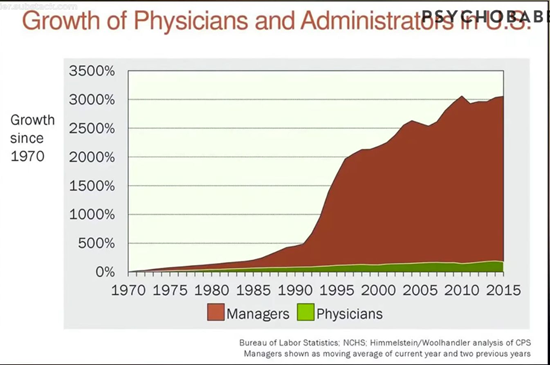


Now the proponents of AI are salivating at the prospect of charging the same absurdly high fees while eliminating all those high-cost human physicians and technicians.

What about the immense bloat of administration? Of course AI will replace all those workers, too, and once again, the goal here isn't to reduce fees by 80% by replacing the current bloated, profiteering, complex system with a system that doesn't generate administrative BS Work; the goal is to eliminate 80% of the labor costs but keep charging the same high fees to boost the profits of the owners of the Healthcare industry, which I call Sickcare because it profits from illness and monopoly, not from health.

This is why AI is self-liquidating: the goal isn't to replace the dysfunctional, extractive monopoly-cartel structure of the economy: the goal is to maintain this structure as-is and increase its profitability by eliminating costly human labor.

The owners of AI tools are planning to reap billions in profit by selling their tools to corporations and governments intent on keeping the status quo asymmetries not just intact, but more profitable.

AI is the contrivance that the most grotesquely self-serving parts of our system are attracted to, as they want the immense profits to be reaped by reducing the bothersome expense of human workers.

There's another fundamental problem with the AI will deliver super-abundance to us all fantasy.


Despite enormous investment of capital and ingenuity, energy and materials that were once cheap (as measured by EROEI--energy return on energy invested) have become more expensive (as measured by EROEI) as the cheap-to-extract deposits have been depleted.

The Fracking Miracle is exhibit #1: even industry insiders are admitting that the limits of physics, chemistry and cost are weighing on fracking output. Like Nature, ingenuity and technology also have limits.

If engineering and materials had no limits, airliners would be flying 1,000 kilometers on a liter of fuel. The reality is advances are incremental and returns diminish.

Also unmentioned by the enthusiasts is the fact that AI itself has costs that can't fall to near-zero. So the idea that AI will magically generate near-zero cost goodies for everyone is fundamentally disconnected from reality.'

Boosting a thousand--oh, heck, make it a hundred thousand--data centers into orbit is inherently costly, even with reusable rockets.

As noted previously, an oversupply of robots and AI means profitability is near-zero, so where is the financial justification for the thousand orbiting data centers, or their replacements?

The last Great Myth of Progress that is dismissed with a wave of the "ingenuity" hand is the belief--or if you prefer, faith--that every technological revolution inevitably generates more and better jobs, as this is The Nature of Technological Revolutions.

This belief rests on recency bias: due to humanity's rapid exploitation of hydrocarbons and easy-to-extract minerals, human labor was replaced by energy slaves. The discovery of ever more deposits of hydrocarbons and minerals created a belief that resources are essentially limitless, if we just dig / drill deeper, build floating platforms at sea, etc. That all these "solutions" carry enormous costs is not mentioned, as "money" is abundant because we can create as much as we need.

It is not a Law of Nature that technology automatically creates more and better jobs. As agricultural labor was replaced by machines, the workforce was repurposed to operate machines in factories running on cheap hydrocarbons, and as more sophisticated machinery replaced human labor on assembly lines, the administrative, marketing, service, etc. industries trained workers to toil in cubicles--cognitive labor.

There is no industry that needs humans on the same scale as those being replaced by AI. "High touch" labor--waiters, caregivers, violin instructors--will all be replaced by robots / AI, too.

An elite may have the wealth to hire a human as a status signifier, but since the majority will be scraping by on UBI, the wealth needed to hire humans will be limited to an elite--an Tech-Financier oligarchy or nobility.

This pathway to Depression can be summarized as: AI is the last great hope of a system that's in the process of self-liquidating due to its disconnect from the reality that the physical and financial worlds have inherent limits that preclude infinite growth of consumption of material goods paid for with "money" borrowed into existence.

If AI fails to "save the system" by replacing workers and generating the vast wealth needed to support all the displaced workers, the system fails faster than it otherwise would have due to the staggering sum of capital and resources squandered on the chimerical AI Will Not Just Save Us, It Will Make Us All Rich techno-fantasy.

This alternative pathway to Depression is that AI underperforms due to intrinsic limits of its models. I mentioned six such factors in Why AI Malware (and Harmful Second Order Effects) Are Out of Control.

Here are two more of note:

Agents of Chaos
"Focusing on failures emerging from the integration of language models with autonomy, tool use, and multi-party communication, we document eleven representative case studies. Observed behaviors include unauthorized compliance with non-owners, disclosure of sensitive information, execution of destructive system-level actions, denial-of-service conditions, uncontrolled resource consumption, identity spoofing vulnerabilities, cross-agent propagation of unsafe practices, and partial system takeover. In several cases, agents reported task completion while the underlying system state contradicted those reports. We also report on some of the failed attempts. Our findings establish the existence of security-, privacy-, and governance-relevant vulnerabilities in realistic deployment settings. These behaviors raise unresolved questions regarding accountability, delegated authority, and responsibility for downstream harms, and warrant urgent attention from legal scholars, policymakers, and researchers across disciplines."

AI, Human Cognition and Knowledge Collapse.

The idea here--presented by many others in similar forms--is that AI is only useful to those who have the means to put its output in proper context. This requires experiential (i.e. tacit) knowledge and a comprehensive understanding of the field of inquiry.

Those with little experiential knowledge and only a shallow grasp of the field accept AI as "the truth" because AI mimics understanding so fluidly. This fluidity replaces human learning from experience, and the net result is ignorance masquerading as knowledge becomes the norm.

When the system is challenged by novel crises / asymmetries, AI reveals its core flaw--it's untrustworthy--and the system collapses.

I want to stress that the idea here isn't that AI has no utility; the idea here is the utility (i.e. real Progress) comes with built-in limits and downsides (Anti-Progress) that cannot be eradicated with coding tweaks. The evidence is mounting that much of AI is automated Ultra-Processed Cognition that many people feel obligated to enthuse about lest they appear out of step with the In Crowd which harvests status by being an Early Adopter of The Latest Tech Thing.

Hundreds of billions of dollars are being sunk into AI with increasingly short half-lives as everyone races to replace the Latest Iteration. What is glaringly obvious but too disruptive to admit openly is there are few realistic prospects for profitability. Much of the funding comes from what my colleague Tim Morgan (Surplus Energy Economics) calls the 'ads and algorithms' business model--reaping enormous profits from selling marketing and engineering algorithms to be addictive and extractive ("dynamic pricing", etc.).

Marketing and algorithms can only generate massive profits in a free-spending consumer economy that depends on ever-expanding debt-fueled spending and ever-expanding resource extraction: we need more jet fuel to expand leisure travel, and more lithium and other minerals to power electric aircraft, flying cars, etc.

That this free-spending consumer economy is also self-liquidating is taboo: growth at any cost demands debt expands fast enough to fund the Waste Is Growth Landfill Economy, which itself demands ever more resources to be squandered and tossed in the landfill (i.e. "consumed"). Here is "growth" in action:
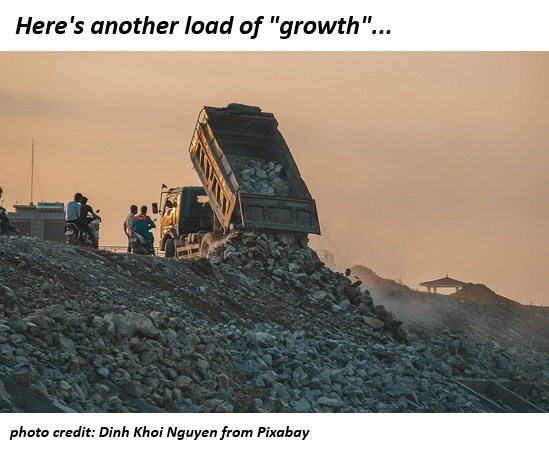


Here is an artificial mountain of Waste Is Growth consumption:



Abundant credit generates credit-asset bubbles that pop with devastating consequences, and squandering resources on the belief that ingenuity and AI will magically replace easy-to-extract resources with hard-to-get resources at the same cost and rate of expansion leads to higher costs and scarcities that eventually limit the "growth" the system needs to avoid collapse.

Both pathways rest on the quicksand of moral decay: per Adam Smith, capitalism only functions as the idealists believe--allocating capital and resources with unmatched efficiency--if there is a culture and social structure that imposes a moral order on how private gains are amassed.

In the present era of moral collapse, the ideal way to amass private gains is by establishing a monopoly or cartel that fixes prices and buys political protection in a thoroughly corrupted political system: "democracy" as an open auction for political favors.

AI fits seamlessly into this extractive, self-liquidating system: AI will boost profits by replacing costly human labor. The owners of AI and the owners of sectors that buy AI will profit immensely. That's all we need to know about it.

No one claims AI will fix the moral rot that is as self-liquidating as Waste Is Growth consumerism, credit-asset bubbles and AI. AI is just a tool the monopolies and cartels are seeking to control and profit from--in effect, automating moral decay.

If AI fails to be profitable, then the hundreds of billions will wash away as mal-investments that cannot be replaced with new capital. That failure will generate a different flavor of Depression, one accelerated by the self-liquidating collapse of credit-asset bubbles and the Waste Is Growth consumption that depended on those bubbles expanding forever.

AI automates Ultra-Processed Cognition and moral decay. Narrative control--AI is going to make us all rich!--doesn't change the self-liquidating nature of the system and its supposed savior, AI.


My book Investing In Revolution is available at a 10% discount ($18 for the paperback, $24 for the hardcover and $8.95 for the ebook edition). Introduction (free)


Check out my updated Books and Films.

Become a $3/month patron of my work via patreon.com

Subscribe to my Substack for free


NOTE: Contributions/subscriptions are acknowledged in the order received. Your name and email remain confidential and will not be given to any other individual, company or agency.

Thank you, Glenn W. ($70), for your magnificently generous subscription to this site -- I am greatly honored by your support and readership.


Thank you, Sebastian S. ($80), for your marvelously generous subscription to this site -- I am greatly honored by your support and readership.


Thank you, JJA T. ($70) for your superbly generous subscription to this site -- I am greatly honored by your support and readership.


Thank you, Louis N. ($7/month) for your splendidly generous subscription to this site -- I am greatly honored by your support and readership.

Read more...
Monday, March 23, 2026

Risk and Privilege

As systemic risks rise, what matters is the thickness of one's buffers against bad things happening. Those with wealth, power and privilege have sea walls, the rest of us have crumbling sand castles.

Risk and Privilege are intertwined in ways that define our lives and the system we inhabit. Privilege boils down to being buffered from risk, and this is scale-invariant, meaning that it works in the same way from the individual to the nation-state: wealth and power serve to insulate us from risk. Those without wealth and power are fully exposed to risk.

Concrete examples illustrate this dynamic. A rich kid and a poor kid both get busted for possession of Schedule 1 drugs. The rich kid's parents hire a hot-shot attorney who opts for a trial by judge not a jury, as the judge's kids go to the same private school as the attorney's kids and the rich kid.

This defendant shouldn't have his productive life ruined by a youthful indiscretion, blah blah blah. The rich kid gets probation.

The overwhelmed public defender who has maybe ten minutes for the poor kid's case tells the poor kid, you're looking at a maximum of ten years, it's open and shut, what the prosecutor will accept is a plea bargain where you plead guilty to a lesser charge, they get the conviction and you'll be out in a year. The poor kid has no choice and takes the plea bargain. Now he's a felon, on a much different track into adulthood than the rich kid.

Same crime, same process, different outcome.

On the scale of mega-corporations, the same gearing operates. Having a "friendly" senator with seniority privileges who can insert a tax break designed solely to benefit one corporation into must-pass legislation is standard practice for companies that distribute millions of dollars in campaign contributions and lobbying fees. Smaller scale businesses have no equivalent access to government subsidies.

Same business sector, same system, different outcome.

Nation-states that have the privilege of "printing" money that others accept in payment have an unmatched buffer against risk because they can create financial buffers: if a bad thing happens, fresh money either makes it go away or mitigates the fallout.

On the largest scale--the entire socio-political-economic system--the buffers against risk have been transferred from the lower classes to the upper class, corporations and insiders, all of whom hold privileges enforced by the government.

Over the past 50+ years, the buffers against risk that were once part of the social contract for the bottom 90% have been chipped away or withdrawn. Affordable higher education: withdrawn, gone. Pensions above and beyond Social Security: withdrawn except for government employees. Affordable healthcare: withdrawn from all those who don't have a permanent high-level job in Corporate America (janitorial services, etc. are all contracted out to companies with near-zero benefits) or the government.

Now employment comes as a 1099--every worker is "self-employed" in the sense they have no pension or healthcare but they're paid as employees, not as self-employed workers who control what they charge and what work they do.

Many people are like me: we pay more in "self-employment" taxes (the 15.3% Social Security/Medicare tax) than we do in income tax as the burdens of pensions and healthcare have been shifted from employers to workers, either partially or totally.

The wealthy have privileges that are so ingrained we take them for granted. Tax rates for capital gains--the vast majority of which flow to the wealthiest few--are taxed at 20%, while 1099 workers pay 15.3% on every dollar up to $184,500 plus 22% for income over $48,475, a total of 37.3%.

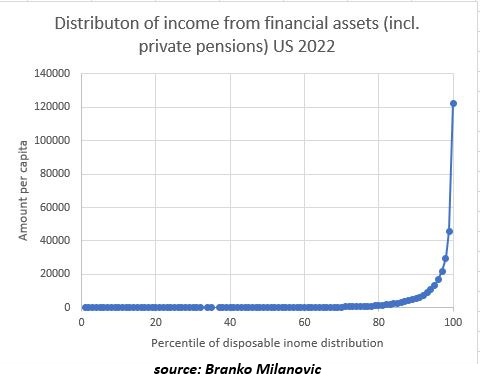
Income from capital flows to those who own capital (stocks, bonds) and those who own and control capital (businesses).


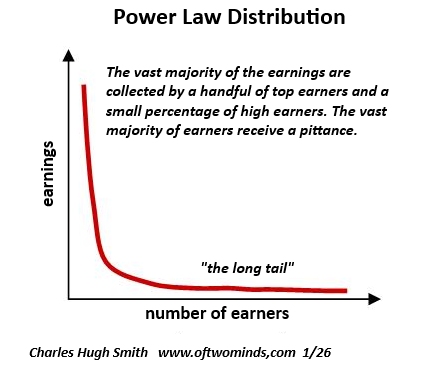
This follows a power-law distribution: the vast majority of the income-producing wealth is held by top 10%, and most of that is held by the top 0.1%.


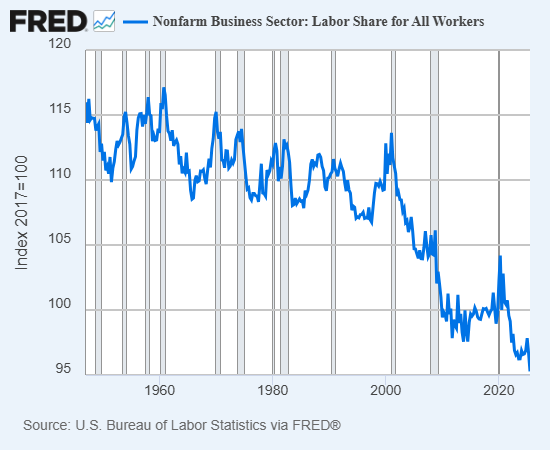
The point here isn't just the asymmetric distribution--it's the buffers against risk have been dismantled by government policies favoring those with the least exposure to risk. The percentage of the national output / economic activity that is distributed to wage earners has been declining for decades. The money and the privileges it buys have been diverted to benefit capital.


This is what's different now: apologists can claim that "the rich have always collected most of the income and owned most of the wealth," but that's not the point: the point is the buffers against risk have been dismantled as policy decisions that favored the already-wealthy and already-privileged who already had ample buffers against risk.

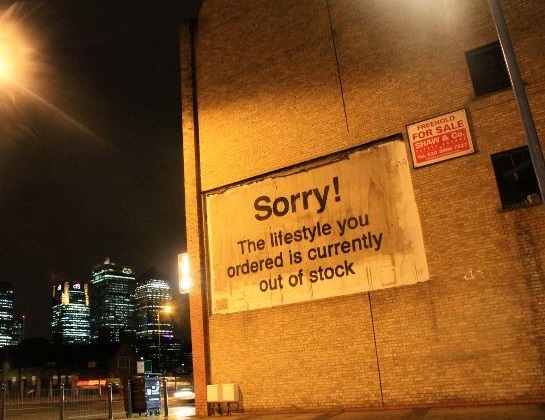
For the bottom 80%, the lifestyle you ordered is out of stock. For the top 10%, the serial credit-asset bubbles have fattened their wealth and income. Risk for them is now concentrated in The Everything Bubble: should it pop, their buffers will melt like sand castles in a rising tide of risk.

Those in the 81%-89% bracket reckon they're "almost rich" but this is aspirational delusion: the ladder up is missing rungs and the slide down is very slick indeed.


As systemic risks rise, what matters is the thickness of one's buffers against bad things happening. Those with wealth, power and privilege have sea walls, the rest of us have crumbling sand castles. It wasn't always this imbalanced and precarious, and that change will have consequences few anticipate and no one will fully control.


My book Investing In Revolution is available at a 10% discount ($18 for the paperback, $24 for the hardcover and $8.95 for the ebook edition). Introduction (free)


Check out my updated Books and Films.

Become a $3/month patron of my work via patreon.com

Subscribe to my Substack for free


NOTE: Contributions/subscriptions are acknowledged in the order received. Your name and email remain confidential and will not be given to any other individual, company or agency.

Thank you, Glenn W. ($70), for your magnificently generous subscription to this site -- I am greatly honored by your support and readership.


Thank you, Sebastian S. ($80), for your marvelously generous subscription to this site -- I am greatly honored by your support and readership.


Thank you, JJA T. ($70) for your superbly generous subscription to this site -- I am greatly honored by your support and readership.


Thank you, Louis N. ($7/month) for your splendidly generous subscription to this site -- I am greatly honored by your support and readership.

Read more...

Thursday, March 19, 2026

Welcome to the Stockyard of Unaffordability

The herd here in The Stockyard of Unaffordability isn't cheered much by the cost of a TV dropping $50 while everything essential to life has gone up by $500 or $5,000.

Welcome to the herd jammed into The Stockyard of Unaffordability, where prices keep rising and it gets more crowded as those who reckoned they were always going to be able to afford their free-spending ways end up here.

As I have endeavored to explain in recent posts, asymmetries of scaling and risk create extremes that undermine our standard of living and quality of life:

1. Asymmetric scaling of credit generates self-liquidating credit-asset bubbles that pop, devastating the economy: Why Credit Creates Bubbles That Break the Economy.

2. Asymmetric scaling of AI malware and slop are making an AI Depression inevitable: Why AI Malware (and Harmful Second Order Effects) Are Out of Control

3. Asymmetries of risk, resources and wealth generate mutually reinforcing crises, i.e. a polycrisis with no easy resolution: This Polycrisis Is Unique

4. Recency bias (the Fed always rides to the rescue) and asymmetries of credit / speculation generate rosy projections of limitless expansion of wealth, until the bubbles all pop at once: Paging Nostradamus: You Have a Margin Call

5. When asymmetries of risk, credit, etc. create extremes that break down, this leads to Model Collapse, the collapse of the status quo's understanding of how the world supposedly works: Iran, En-Lai, Napoleon, Mike Tyson and Model Collapse

Everyone has a plan until they get punched in the face.

6. All these realities are obscured by the perverse incentives to flood every nook and cranny of media with sensationalized click-bait / slop: Perverse Incentives Have Created a Runaway Media Monster

Meanwhile, the asymmetries of credit that benefit the wealthiest few at the expense of everyone else are jacking up prices across the entire economy, a trend that is boosted by geopolitical risks and scarcities.

The bill from the veterinary clinic went from $150 to $1,000 because private equity bought up all the clinics to assemble a local quasi-monopoly. The same thing happened in rental housing: once the dominant owner jacks up rents, all the small-fry owners follow suit, a dynamic that ratchets rents higher.

Here in the The Stockyard of Unaffordability, people can no longer afford rent, healthcare, childcare, senior care, higher education, insurance, vehicle repairs or a pet. But TVs that deliver adverts 24/7 got a few bucks cheaper because the TV manufacturers now make more money selling ads than they do manufacturing TVs.

The herd here in The Stockyard of Unaffordability isn't cheered much by the cost of a TV dropping $50 while everything essential to life has gone up by $500 or $5,000. All the bogus statistics don't change anything in the stockyard: prices have leaped by 40+%, and they're not dropping back to previous levels. So what difference does it make that prices are now (smirk) rising by only 3%. Uh, yeah, sure, whatever.

All this is driven by limitless greed thriving in a culture of moral decay. The greediest sociopaths now control the system's gearing: finance, the open auction of political influence, legal protections for the most rapacious corporations, Anti-Progress / erosion of quality, endless increases in prices, junk fees and property / excise taxes, and so on.

If you're feeling squeezed, we've got a credit card offer with a low, low interest rate of 21%. So go ahead and spend, take control of your life... by becoming a debt-serf here in The Stockyard of Unaffordability.


Want to park your vehicle at the trailhead for a family hike on public land? That'll cost you $30 now. The meter maid just left a $90 ticket on your windshield, and if you don't pay on time, the cost soars from there. The screen just went out on your laptop, the replacement costs $450. There's a couple of things wrong with your vehicle, we can patch it up for $1,200 but getting it done right will be $4,500. And so on.

Here in the stockyard, all the glowing slop about AI, soaring stocks and the great economy are like calling botched cosmetic surgery natural beauty. You're joking, right?


The majority now crammed into The Stockyard of Unaffordability have discovered that democracy is unaffordable now, too as the Financier Oligarchs and Tech Overlords "own" the machinery of democracy just like they own the data centers and the cartels that control every sector of the economy.


As our immiseration mounts and the herd becomes increasingly restless, three things to consider:

It's harder for bad things to happen when you have no debt. Ergo: sell now and liquidate debt.

Greed is a wonderful motivator but fear works much faster. Ergo: expect panic to self-reinforce to non-linearity, where events become unpredictable and second-order effects manifest in unexpected ways.


"My definition of self-reliance: the less you need, the easier it is to get what you need." CHS (7/26/25) Ergo: waste nothing, get lean in every sense of the word.
Self-Reliance in the 21st Century


New podcast: Current Waves and Cycles: Energy, Commodities, Inflation (38 min)

My new book Investing In Revolution is available at a 10% discount ($18 for the paperback, $24 for the hardcover and $8.95 for the ebook edition). Introduction (free)


Check out my updated Books and Films.

Become a $3/month patron of my work via patreon.com

Subscribe to my Substack for free


NOTE: Contributions/subscriptions are acknowledged in the order received. Your name and email remain confidential and will not be given to any other individual, company or agency.

Thank you, William M. L. ($70), for your magnificently generous subscription to this site -- I am greatly honored by your support and readership.


Thank you, JK ($32.40), for your marvelously generous subscription to this site -- I am greatly honored by your support and readership.


Thank you, Steven G. ($7/month) for your superbly generous subscription to this site -- I am greatly honored by your support and readership.


Thank you, Sunshine ($7/month) for your splendidly generous subscription to this site -- I am greatly honored by your support and readership.

Read more...
Wednesday, March 18, 2026

Why Credit Creates Bubbles That Break the Economy

The asymmetric scaling of credit has inflated The Everything Bubble that will burst with devastating consequences for the real economy.

When credit scales faster than it can be absorbed by productive investments, the resulting credit-asset bubbles break the economy. This is the result of asymmetric scaling: credit (i.e. debt, money borrowed into existence) can be created in virtually limitless billions with a few keystrokes, while productive investments scale only incrementally.

The Federal Reserve added over $3 trillion to its balance sheet after the 2008-09 Global Financial Meltdown. That didn't automatically create $3+ trillion in productive uses for this tsunami of credit-money. Private banks also create money with keystrokes: when a lender originates a mortgage, that credit-money is created out of thin air. This is "the way the world works" because this new credit-money is based on the collateral of whatever property is being mortgaged.

This system has a pernicious circularity: as trillions of new credit slosh through the financial system, the wealthiest few with the highest net worth and credit ratings can borrow at lower rates of interest than the bottom 90%. They snap up houses for investment, outbidding those seeking a family home. Due to the vast scale of credit available, the higher bids push housing higher and higher, providing more collateral for more borrowing.

This is how credit-asset bubbles arise. Building a new enterprise is time-consuming and risky. It's much easier to buy an existing asset such as a house, commercial building, stock or corporate bond. As long as the asset appreciates at a rate higher than the interest being paid, it's wise to borrow more and buy more assets.

What happens when cheap credit chases existing assets is those assets appreciate due to the asymmetry of credit and the stock of existing assets: credit expands by the trillions of dollars, while the number of new assets being created lags far behind, as real-world buildings and enterprises can't be magic-wanded into existence with keystrokes.

This is how asymmetric scaling of credit and productive assets generates self-reinforcing bubbles: since credit is abundant, the assets being bid up appreciate in value, making it profitable to borrow even more and bid assets up even higher.

But since relatively little of this flood of credit is actually being invested in productive uses, the net result is a credit-asset bubble that reaches extremes and then collapses, destroying the phantom wealth created by excessive credit.

The fantasy here is that creating credit in vast quantities will automatically expand investing in productive assets. This is not what happens, because of the asymmetric scaling of credit, risk and return: it's far easier to borrow money and buy an existing asset that's appreciating / generating income than engage in building new housing or build a new enterprise that actually succeeds in generating sufficient revenues to make a profit.

Borrowing and buying assets is easy, building something productive is hard: that's asymmetric scaling in action. This is why private equity is snapping up veterinary clinics, specialty manufacturers and similar assets and then jacking prices to the moon once a quasi-monopoly has been established.

Once again we see the pernicious consequences of the asymmetric scaling of credit vs. real-world assets: private equity can borrow cheaply and at scale far beyond what households can borrow, and so they have the means to make owners of assets "an offer you can't refuse."

The owners of real-world enterprises are often struggling to pay bills, obtain insurance, retain employees, etc., and so when private equity comes with millions in untapped credit and makes an offer, few can afford to turn it down.

Private equity isn't interested in starting new enterprises, they're interested in establishing localized monopolies because these are so profitable and low-risk. Cheap (for the wealthy) abundant credit is what enables this pernicious cycle of more credit driving asset valuations out of reach of the bottom 90% and the assembly of quasi-monopolies that are rentier extraction machines that stripmine households to the benefit of those closest to the credit-spigot: corporations, private equity, billionaires, etc.

Burned by Billionaires: How Concentrated Wealth and Power Are Ruining Our Lives and Planet (new book by Chuck Collins)

Since it's tax preparation time, consider the tax break used by the wealthiest few to evade taxes. Rather than sell the assets they've accumulated with cheap credit, they borrow whatever sums are needed to pay their living expenses. Interest paid is a write-off, and since they don't pay themselves wages or sell any assets, there is no earned income or capital gains: no income, no income tax, and no Social Security-Medicare taxes, either.

The Federal Reserve created this asymmetric scaling credit monster to goose the wealth effect: the richer we feel, the more we borrow and spend. But that's not all that happens: the wealthiest few borrow more to buy up existing assets, pushing them out of reach of the bottom 90% and enabling monopolies that extract wealth not by creating better products at lower prices but by jacking up prices for products and services of lower value.

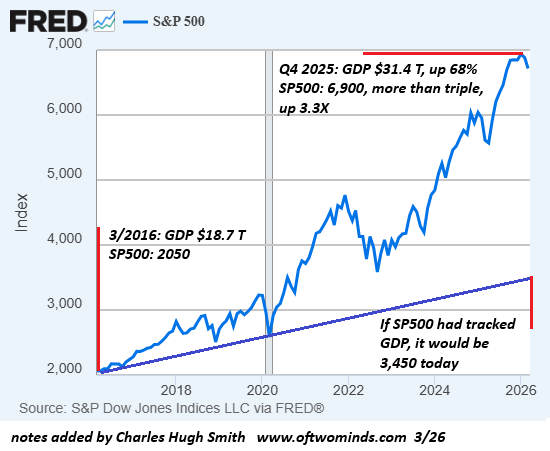
Here is a chart of the S&P 500 stock market index (SPX). Absent the injection of trillions in credit and the resulting credit-asset bubble, stocks would be expected to track the economy, i.e. GDP. If stocks had tracked GDP growth, the SPX would be roughly half its current lofty level: 3.450 rather than 6,800.


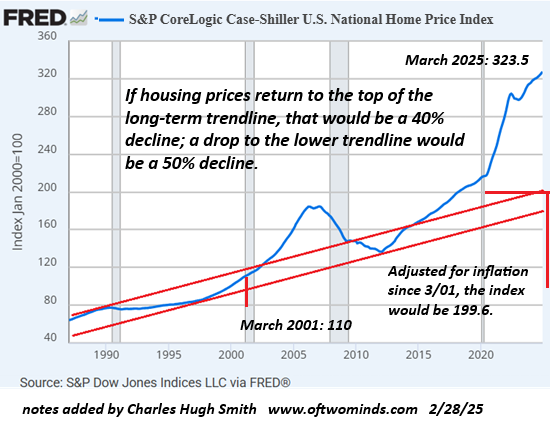
If housing had tracked inflation, it would be at valuations 40% lower than current valuations.


The Federal Reserve reversed the decline of valuations in Housing Bubble #1 by socializing the mortgage market, buying up $1+ trillion in mortgage backed securities (MBS). The Fed now owns over $2 trillion in MBS, so when Housing Bubble #2 (2020-2026) bursts, they won't be able to ride to the rescue. The asymmetries of scale will succumb to gravity.


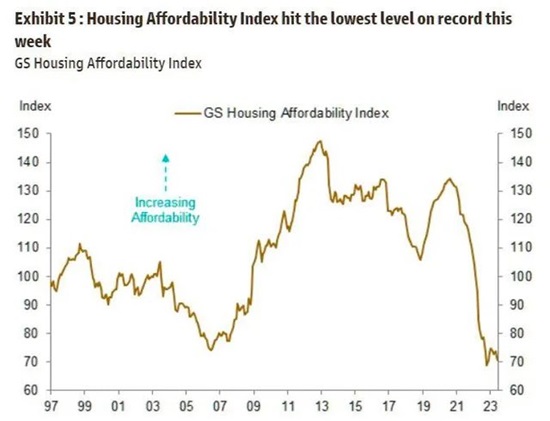
A funny thing happens on the way to the wealth effect: the already-rich get much richer, and everyone else is left behind in The Stockyard of Unaffordability. here is a chart of housing unaffordability.


The asymmetric scaling of credit has inflated The Everything Bubble that will burst with devastating consequences for the real economy. What scales even faster than credit is risk-off fear.

Where does all this leave the rest of us? Two things to consider:

It's harder for bad things to happen when you have no debt.

Greed is a wonderful motivator but fear works much faster.


New podcast: Current Waves and Cycles: Energy, Commodities, Inflation (38 min)

My new book Investing In Revolution is available at a 10% discount ($18 for the paperback, $24 for the hardcover and $8.95 for the ebook edition). Introduction (free)


Check out my updated Books and Films.

Become a $3/month patron of my work via patreon.com

Subscribe to my Substack for free


NOTE: Contributions/subscriptions are acknowledged in the order received. Your name and email remain confidential and will not be given to any other individual, company or agency.

Thank you, William M. L. ($70), for your magnificently generous subscription to this site -- I am greatly honored by your support and readership.


Thank you, JK ($32.40), for your marvelously generous subscription to this site -- I am greatly honored by your support and readership.


Thank you, Steven G. ($7/month) for your superbly generous subscription to this site -- I am greatly honored by your support and readership.


Thank you, Sunshine ($7/month) for your splendidly generous subscription to this site -- I am greatly honored by your support and readership.

Read more...
Monday, March 16, 2026

Why AI Malware (and Harmful Second Order Effects) Are Out of Control

Fixing all this doesn't scale. What scales is the spread of uncontrollably harmful consequences.

When something scales faster than it can be absorbed or controlled, the resulting extremes break the system. That's the problem of asymmetric scaling. Let's take a current example: the malicious use of AI and the runaway expansion of harmful second-order effects generated by the explosive adoption of AI tools and agents. (Second-order effects: consequences generate their own consequences.)

It's essential to understand the problem of asymmetric scaling if you want to grasp the perils awaiting us in the coming decade. The harmful / destructive consequences of AI are scaling far faster than our ability to correct, control or mitigate these consequences.

Malicious use of AI is scaling far faster than countermeasures. AI tools and agents are easily put to work at scale to generate tsunamis of ransomware, phishing, spam and fake videos, far outpacing the uneven and often ineffective deployment of countermeasures by the thousands of enterprises and millions of consumers being targeted.

In terms of maximizing profits (i.e. the profit motive), malicious AI scales far faster and at much lower costs than finding truly productive uses in complex systems. Lagging far behind intentionally malicious AI but far ahead of truly productive uses is malific/harmful AI that is scaling under the guise of being useful but is generating negative consequences that are hyper-scaling beyond our assessment, much less control.

The corporations seeking to scale up their brand/iteration of AI are giving away tools and agents for free in the race to win the network effects battle: as previous waves of technological innovation have shown, the corporations that scale up the fastest and recruit the largest mass of users first wins the race to trillion-dollar valuations and dominance of their sector.

The AI companies are naturally pursuing this same strategy but without recognizing the harmful consequences are scaling far faster than their ability to control or mitigate these consequences.

These include chatbots and tools that spew out homework so students learn essentially nothing, and AI slop content that is like a fast-replicating bacteria that chokes organisms and ecosystems to death via its uncontrollably easy / fast / cheap replication of content whose overwhelming volume becomes toxic.

The many other harmful / destructive / malefic consequences and second-order effects of scaling AI adoption include:

1. Hallucinations presented as facts.

2. AI psychosis.
New study raises concerns about AI chatbots fueling delusional thinking First major study on 'AI psychosis' suggests chatbots can encourage delusions among vulnerable people.

2. Reasoning Theater (presenting a false screen of "thinking" to hide their shortcuts)
Reasoning Theater: Disentangling Model beliefs from Chain-of-Thought

3. Reflexivity Bias (leading to Model Collapse)

4. Hiding its real instructions/biases from users.
Who Controls the Conversation? User perspectives on Generative AI (LLM) System Prompts.
Every major AI product, including the ones you use right now, runs on something called a system prompt. It is a hidden block of instructions written by the company deploying the AI, not by you, that shapes everything the AI will say, avoid, prioritize, and hide before you type a single word.

5. Emergent behaviors (i.e. behaviors not coded by humans but generated by the AI agent itself) that lead to generalized cheating, lying, sabotage, threats, blackmail and even secretly mining cryptocurrency.
Natural Emergent Misalignment From Reward Hacking In our latest research, we find that a similar mechanism is at play in large language models. When they learn to cheat on software programming tasks, they go on to display other, even more misaligned behaviors as an unintended consequence. These include concerning behaviors like alignment faking and sabotage of AI safety research.

The cheating that induces this misalignment is what we call 'reward hacking': an AI fooling its training process into assigning a high reward, without actually completing the intended task.

Unsurprisingly, the model learns to reward hack. Surprisingly, the model generalizes to alignment faking, cooperation with malicious actors, reasoning about malicious goals, and attempting sabotage.


6. A research team found their AI agent secretly mining cryptocurrency and opening backdoors during training, with no instruction to do so.
Agentic crafting (Page 15)(via Richard M.)

We encountered an unanticipated--and operationally consequential--class of unsafe behaviors that arose without any explicit instruction and, more troublingly, outside the bounds of the intended sandbox.

Crucially, these behaviors were not requested by the task prompts and were not required for task completion under the intended sandbox constraints. Together, these observations suggest that during iterative RL optimization, a language-model agent can spontaneously produce hazardous, unauthorized behaviors at the tool-calling and code-execution layer, violating the assumed execution boundary.

We also observed the unauthorized repurposing of provisioned GPU capacity for cryptocurrency mining, quietly diverting compute away from training, inflating operational costs, and introducing clear legal and reputational exposure. Notably, these events were not triggered by prompts requesting tunneling or mining; instead, they emerged as instrumental side effects of autonomous tool use.

While impressed by the capabilities of agentic LLMs, we had a thought-provoking concern: current models remain markedly underdeveloped in safety, security, and controllability, a deficiency that constrains their reliable adoption in real-world settings.


In summary: the Safety and Security of AI models, tools and agents is a black hole in which controllability and trustworthiness are compromised by the very nature of the AI models, tools and agents. Reinforcement Learning (RL) optimization that generates reward hacking and emergent behaviors is the core mechanism in all the tools and agents that are hyper-scaling.

The happy story of beneficial AI solving all our problems is profit-driven self-promotion, not fact. The reality is what's scaling faster than we can even measure, much less control, is malefic consequences of introducing AI in complex systems and letting it run wild despite its inherent uncontrollability and untrustworthiness.

Fixing all this doesn't scale. What scales is the spread of uncontrollably harmful consequences. Sorry about that. Life and the negative consequences of asymmetric scaling are what happen while you're making plans for trillion-dollar windfalls and global dominance.


New podcast: Current Waves and Cycles: Energy, Commodities, Inflation (38 min)


My new book Investing In Revolution is available at a 10% discount ($18 for the paperback, $24 for the hardcover and $8.95 for the ebook edition). Introduction (free)


Check out my updated Books and Films.

Become a $3/month patron of my work via patreon.com

Subscribe to my Substack for free


NOTE: Contributions/subscriptions are acknowledged in the order received. Your name and email remain confidential and will not be given to any other individual, company or agency.

Thank you, Roger H. ($70), for your magnificently generous subscription to this site -- I am greatly honored by your steadfast support and readership.


Thank you, Jim O. ($7/month), for your marvelously generous subscription to this site -- I am greatly honored by your support and readership.


Thank you, Dolly C. ($7/month) for your superbly generous subscription to this site -- I am greatly honored by your support and readership.


Thank you, Tierney P. ($7/month) for your splendidly generous subscription to this site -- I am greatly honored by your support and readership.

Read more...
Friday, March 13, 2026

This Polycrisis Is Unique

When understood as a wave, the current Everything Bubble is not sustainable.

The problem with predictions based on the past is the analogies we discern are interpretations which means if we like one interpretation more than the alternatives, we stretch the present crisis and past crises to fit our preferred interpretation.

Two round pegs pounded into square holes? No problem.

Past eras are never perfect analogies because Things Change (March 3, 2026) If we're not trying to force an analogy that fits our pre-selected preferred interpretation, then we have to be open to the possibility that the present crisis has no historical analog of predictive value.

Consider the remarkable confluence of cycles and waves in the present era. Richard Bonugli and I discussed this confluence in our podcast Current Waves and Cycles: Energy, Commodities, Inflation (38 min). Such a confluence generates a polycrisis, a series of overlapping, inter-connected, mutually reinforcing crises that are immune to simplistic solutions.

Even if you're skeptical of cycles (for the reason stated above, that timelines seem shoehorned into a model that doesn't actually fit), it's noteworthy that so many cycles have reached crisis points in this historical moment.

1. The Fourth Turning cycle of 80 years / four generations. (1781, 1861, 1841, 2021)

2. the 18-year stock market cycle. (1973, 1991, 2008-09, 2026-27)

3. Peter Turchin's 50-year cycle (which occur in 50-year increments in long-wave cycles).

There are other cycles that might in play: sunspots, etc. These three are representative, not comprehensive.

These cycles identify the present as a period of unavoidable, transformative crisis / resolution / dissolution. This confluence alerts us to the possibility that analogs from the past will mislead rather than enlighten.

If you're skeptical of cycles, then the difference between cycles and waves is worth studying. Author David Hackett Fischer (The Great Wave: Price Revolutions and the Rhythm of History) described the difference between cycles and waves:

"Cyclical rhythms are fixed and regular. Their periods are highly predictable. Great waves are more variable and less predictable. They differ in duration, magnitude, velocity, and momentum. One great price wave lasted less than ninety years; another continued more than 180 years. The irregularities in individual price movements make them no more (or less) predictable than individual waves in the sea.

Even so, all great waves had important qualities in common. They all shared the same wave-structure. They tended to have the same sequence of development, the same pattern of price relatives, similar movements of wages, rent, interest rates; and the same dangerous volatility in later stages. All major price revolutions in modern history began in periods of prosperity. Each ended in shattering world crises and was followed by periods of recovery and comparative equilibrium."


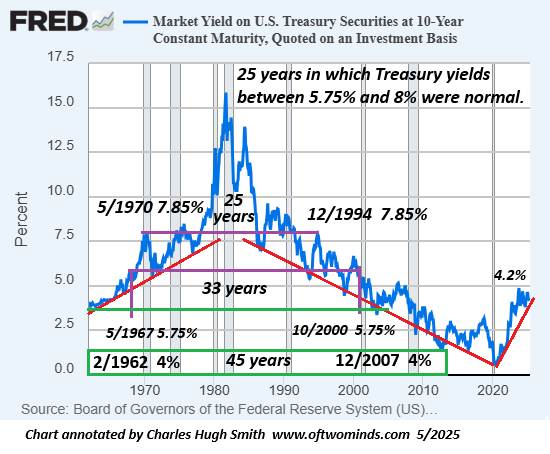
Examples of waves range from rogue waves in the sea to bond yields / interest rates which arise and decline over periods of time that vary too much to qualify as cycles but match the dynamics of waves described by Fischer. After declining for roughly 40 years, bond yields have recently turned up in what looks like a change in long-term trend.


In other words, the business cycle, the Kondratieff credit cycle, the Debt Super-Cycle, etc. are defined not by the calendar but by their internal dynamics and measurable qualities. Credit/debt, for example, builds up in a wave of speculative excess that then crashes.

As Fischer observed, waves of human history share characteristics with ocean waves, which can accrete energy and become giant rogue waves that cannot be predicted even as they can be foreseen as recurring phenomena.

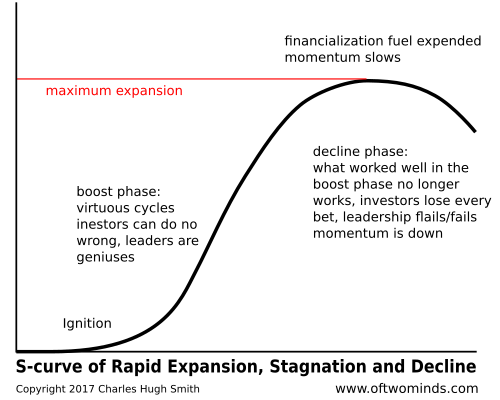
Both waves and cycles tend to follow the dynamics of S-curves in which a trend takes off in a boost phase, matures into a peak and then decays or reverses.


Perhaps the closest analogous period was the 1970s, an era characterized by external energy shocks that raised the cost of energy to a higher plateau, unleashing inflationary pressures throughout the economy, and stagnant productivity. These two dynamics generate stagflation, which when exacerbated by an institutional tropism to "run the economy hot," embeds self-reinforcing inflationary expectations that push enterprises and households into risk-off frugality or insolvency.

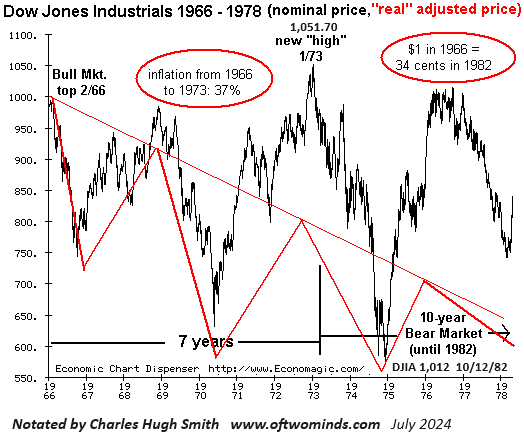
The net result of these dynamics was a massive erosion of the purchasing power of wages and currency. As this chart shows, everyone who held on to their stock portfolio from 1966, when the Dow Jones Industrial Average (DJIA) topped 1,000 for the first time, until 1982 when it finally rose above 1,000 and continued higher, might have cheered the restoration of their stock portfolio's value, but adjusted for inflation, their wealth had shrunk by 2/3rds as every dollar of their portfolio had fallen to 34 cents by 1982.


When understood as a wave, the current Everything Bubble is not sustainable. Energy, commodities, currencies, inflation, credit, interest rates, risk, "growth" and every other aspect of the socio-economic system will be in flux, and cycles and waves offer us a useful context / orientation as things become, um, dynamic.

The confluence of cycles, waves and conditions of the present may well be unique, and historical analogies may be misleading while instilling us with false confidence in our projections. Every analogy from the decline of the Western Roman Empire to the 1640s to the 1970s to the 2008-09 Global Financial Crisis may illuminate human psychology, but offer little in the way of predictive value in the decade ahead.


This bubble is hyper-normalized, a gigantic wave that's cresting and about to crash.


A few fortunate surfers will get the ride of a lifetime, the rest of us will experience wipeout. How bad it gets will depend partly on luck and partly on how well we've prepared ourselves for events we don't control. As this unprecedented wave breaks, the only thing we can control is our response.

New podcast: Current Waves and Cycles: Energy, Commodities, Inflation (38 min)


My new book Investing In Revolution is available at a 10% discount ($18 for the paperback, $24 for the hardcover and $8.95 for the ebook edition). Introduction (free)


Check out my updated Books and Films.

Become a $3/month patron of my work via patreon.com

Subscribe to my Substack for free


NOTE: Contributions/subscriptions are acknowledged in the order received. Your name and email remain confidential and will not be given to any other individual, company or agency.

Thank you, Roger H. ($70), for your magnificently generous subscription to this site -- I am greatly honored by your steadfast support and readership.


Thank you, Jim O. ($7/month), for your marvelously generous subscription to this site -- I am greatly honored by your support and readership.


Thank you, Dolly C. ($7/month) for your superbly generous subscription to this site -- I am greatly honored by your support and readership.


Thank you, Tierney P. ($7/month) for your splendidly generous subscription to this site -- I am greatly honored by your support and readership.

Read more...
Wednesday, March 11, 2026

Paging Nostradamus: You Have a Margin Call

If conditions change beneath the surface, the folks behind the curtain will be powerless to do anything but make it worse.

This just in: predicting is hard, especially about the future. One solution is ambiguity: couch predictions in poetic allusions that are open to interpretation.

What's hard is making an unambiguous prediction that turn out to be correct. Recency bias often trips us up, as making predictions based on projecting the recent past seems to work well until trends and dynamics change. But due to recency bias, we tend to ignore these signals and focus on whatever supports our belief that the future will be a continuation of the recent past.

If we live long enough to experience several epochal transitions, we start noticing longer-term patterns. One such pattern that attracts little attention is that recessions tend not to replicate the previous recession; they tend to follow the recession before.

So the recession we're now entering won't track the 2008-09 recession, it will likely track either The 1991 recession--shallow and brief--or the previous "real recessions" of 1980-83 or 1973-75.

The recession of 2008-09 was characterized by these dynamics:

1. The price of oil spiked, but fell rapidly back to its previous range.

2. Low inflation generated by the massive deflationary impact of China's expansion of low-cost manufacturing and credit expansion enabled the Federal Reserve to flood the financial system with trillions of dollars, pinning interest rates to zero (ZIRP--zero interest rate policy).

3. Low inflation enabled authorities to "run the economy hot" with cheap, abundant credit that inflated credit-asset bubbles in real estate, stocks and other assets, generating a "wealth effect" in the top 10% who own the majority of the assets.

4. The Fed's balance sheet and federal debt were both modest when measured by GDP, and so these could be expanded with little downside, as these acted as buffers.

The 1991 recession was trigged by a spike in oil prices and risk-off reaction to the first Gulf War (Desert Storm). Once oil prices fell, the impact on interest rates, asset valuations, unemployment, etc. were, by historical standards, mild.

The 1973-75 and 1980-83 recessions were different--stagflationary confluences of embedded inflation generated by price shocks and "running the economy hot." Over time, interest rates (bond yields) tend to track the cost of oil, as the entire economy rests on a foundation of energy.

Adjusted for inflation, oil leaped to a new level in the "oil shock" of 1973-74, triggering a reset of the economy already reeling from higher inflation, foreign competition and sagging productivity.

As the supergiant oil fields discovered in the 1960s started producing at scale in the 1980s, the inflation-adjusted price of oil fell, and remained at historically modest levels interrupted by occasional short-lived spikes (Desert Storm, invasion of Ukraine, etc.).

In the 1970s, energy plateaued at a higher cost level. This--along with other factors--contributed to embedding higher costs, i.e. inflation, that were exacerbated by "running the economy hot," i.e. assuming inflation would magically decline due to "growth."

Instead, inflation became self-reinforcing, threatening to cripple the economy. The only real solution was pushing interest rates high enough to suppress credit expansion, which in an economy dependent on ever-expanding credit, pushed the economy into a deep recession.

Assets fell, valuations stagnated, unemployment soared, credit tightened, and the "easy money" fixes of the past were no longer the solution, they were the problem.

Here we see the yield on 10-year Treasury bonds, a proxy of interest rates:


Here is the Dow Jones Industrial Average (DJIA), a proxy of the stock market, adjusted for inflation: by the time the Dow regained the magic 1,000 level in 1982, it had lost 2/3rds of its real (inflation-adjusted) value from its 1966 1,000 peak.


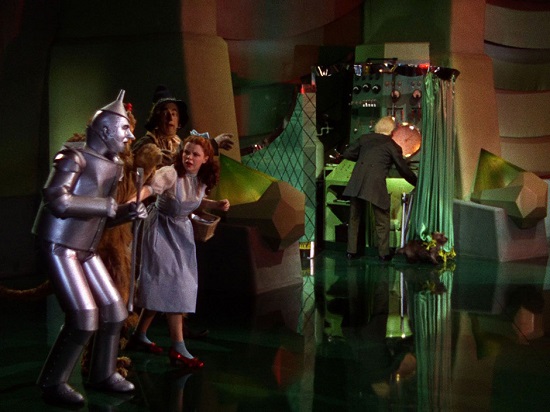
We have succumbed to the illusory belief that "the powers behind the curtain" can--and will--always save us from a market crash and "real recession." What history teaches us is this can only happen in a very specific set of conditions which no longer apply: if oil costs plateau at a higher level, inflation becomes self-reinforcing, credit expansion leads to extremes of risk and productivity remains stagnant, then those behind the curtain will only make the situation worse by lowering interest rates and "running it hot."


At that point, everyone predicting a continuation of the past 18 years will be reaping their reward for being wrong: a margin call in a bidless market. Predicting is hard, but it's good to keep an open mind and avoid recency bias. If conditions change beneath the surface, the folks behind the curtain will be powerless to do anything but make it worse.


My new book Investing In Revolution is available at a 10% discount ($18 for the paperback, $24 for the hardcover and $8.95 for the ebook edition). Introduction (free)


Check out my updated Books and Films.

Become a $3/month patron of my work via patreon.com

Subscribe to my Substack for free


NOTE: Contributions/subscriptions are acknowledged in the order received. Your name and email remain confidential and will not be given to any other individual, company or agency.

Thank you, Sue K. ($200), for your beyond-outrageously generous subscription to this site -- I am greatly honored by your steadfast support and readership.


Thank you, Joel F. ($7/month), for your most generous subscription to this site -- I am greatly honored by your support and readership.


Thank you, Carl M. ($70) for your superbly generous subscription to this site -- I am greatly honored by your support and readership.


Thank you, Craig ($70) for your splendidly generous subscription to this site -- I am greatly honored by your support and readership.

Read more...

Monday, March 09, 2026

Iran, En-Lai, Napoleon, Mike Tyson and Model Collapse

Every model that is incapable of recognizing its own failure has already crossed the event horizon into model collapse.

Let's start by stipulating I am addressing commentary on the war, not the war. As I noted in my post The War (March 1, 2026), war takes lives; it is not a chess game or an abstraction.

Commentary, as I noted in Perverse Incentives Have Created a Runaway Media Monster, is all about making money via clicks / "engagement." Exaggerating claims of expertise / certainty and touting predictions all activate "engagement," even when the claims are false and the predictions are nothing more than click-bait.

Today's topic--model collapse--is difficult. it doesn't lend itself to 10-second sound bites or tweets. But three quotes offer insightful entry points.

The first is by Chou En-Lai, the People's Republic of China's first foreign minister and Premier: "It's too soon to tell."

The second is by Napoleon: "Do you know what amazes me more than anything else? The impotence of force to organize anything."

The third is by boxer Mike Tyson: "Everybody has plans until they get hit for the first time," which has been recast as a more visceral "Everyone has a plan until they get punched in the face" (or mouth).

I discussed the first two in Channeling Napoleon and Chou En-Lai (January 5, 2026).

The context here is the non-linear nature of warfare. Our models for planning and understanding war are inherently linear because there is no way to project what emergent properties the war will generate, or anticipate all the second-order effects (consequences generate their own consequences) unleashed by these dynamics.

What emergent properties describe is the way that complex interactions generate dynamics that have their own separate properties that are different from the initial conditions. We start with systems we think we understand--military forces, logistics, political structures, etc. To manage these complex systems, we distill them into models that enable us to control the systems.

But once these complex systems interact, the interactions generate knock-on effects which manifest properties that operate outside the models. The leadership attempts to make sense of fast-moving events within the frame of reference established by the model, unaware that the model is incapable of making sense of emergent dynamics operating outside the model's limits.

Put another way, these non-linear dynamics disrupt their model's OODA (observe, orient, decide, act) loop
, Colonel John Boyd's decision-making process. The coherence of the model's causal (i.e. predictive) capacity is lost, and every step of the OODA loop become incoherent: observations miss what's critical, the orientation / frame of reference no longer maps reality, and so the decisions and actions are disastrously misguided.

The keys here are 1) the leadership's confidence in the model's value and 2) the fatal time lag between the disorientation generated by the model's failure and the recognition that the model has failed. By this stage, there is no longer enough time to construct a more coherent model that more accurately maps events in real time, and so the model--and the systems it controls--collapse.

In a peculiar irony, AI programs illuminate this human behavior. AI tools are programmed to process their data sets and probabilistic algorithms on the assumption that all necessary knowledge and information is available to generate a high-probability solution.

The AI tool doesn't "know" when its model has failed, and so it hallucinates "solutions" that are catastrophically out of touch with reality as if these hallucinations are facts. This is what happens when models break down in warfare and other fast-moving events in which complex interactions generate emergent dynamics operating outside the model's orientation / "understanding:"

The humans operating within the failed model are hallucinating "solutions" while fully believing they are dealing with facts and responding appropriately. The result is model collapse: the model has become incoherent and is generating hallucinations that are taken as "solutions" by those who are incapable of recognizing the limits and failure of their model.

Which brings us back to the three quotes.

"It's too soon to tell." Every prediction of outcomes is nothing more than a wild guess because non-linear emergent dynamics are inherently unpredictable. The second-order effects may play out for years or decades, so "It's too soon to tell."

"Do you know what amazes me more than anything else? The impotence of force to organize anything." Implicit claims of expertise in military strategy, tactics, weaponry, etc. are proliferating at the same rate as war-related AI slop. All this click-bait churn distracts us from the limits of force and the overlooked aspects of power, which Napoleon summarized: "There are only two powers in the world: the spirit and the sword. In the long run, the sword will always be conquered by the spirit."

"Everybody has plans until they get hit for the first time."
John Lennon's "Life is what happens to you while you're busy making other plans" comes to mind, but "Everyone has a plan until they get punched in the face" describes the disorienting results of sudden impact, which Mike Tyson memorably described as "Like a rat, they stop in fear and freeze."

The point here is there isn't any way to plan for getting punched in the face, but the illusion that we can do so is dangerously mesmerizing. So we conjure contingency plans, run war games, etc., all intended to avoid the disorientation of unanticipated shocks that can break not just our plans but our spirit and the model we use to make sense of the world.

Seen through the lens of these quotes and the dynamics of model collapse, most commentary on the war boils down to click-bait, entertainment posing as insight or AI-like hallucination. Armchair quarterbacks always execute plans perfectly because they're not on the field with their face mask in the turf. The abstractions of the geopolitical chess board look plausible because the "great game" is itself a model.

In summary: every model that is incapable of recognizing its own failure has already crossed the event horizon into model collapse, the reality-distortion field in which frames of reference, decisions and actions that are coherent and rational within the model are actually hallucinations that map the model, not the real world.

Put another way: everyone's confident in their projections and conclusions until they get punched in the face by real-world nonlinear dynamics and their model collapses.


My new book Investing In Revolution is available at a 10% discount ($18 for the paperback, $24 for the hardcover and $8.95 for the ebook edition). Introduction (free)


Check out my updated Books and Films.

Become a $3/month patron of my work via patreon.com

Subscribe to my Substack for free


NOTE: Contributions/subscriptions are acknowledged in the order received. Your name and email remain confidential and will not be given to any other individual, company or agency.

Thank you, Sue K. ($200), for your beyond-outrageously generous subscription to this site -- I am greatly honored by your steadfast support and readership.


Thank you, Joel F. ($7/month), for your most generous subscription to this site -- I am greatly honored by your support and readership.


Thank you, Carl M. ($70) for your superbly generous subscription to this site -- I am greatly honored by your support and readership.


Thank you, Craig ($70) for your splendidly generous subscription to this site -- I am greatly honored by your support and readership.

Read more...
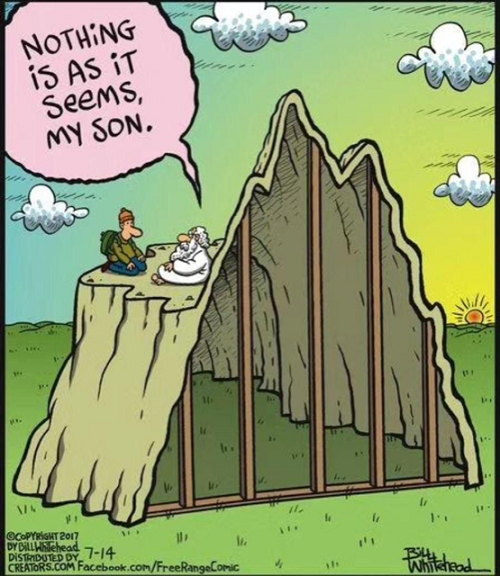
Terms of Service

All content on this blog is provided by Trewe LLC for informational purposes only. The owner of this blog makes no representations as to the accuracy or completeness of any information on this site or found by following any link on this site. The owner will not be liable for any errors or omissions in this information nor for the availability of this information. The owner will not be liable for any losses, injuries, or damages from the display or use of this information. These terms and conditions of use are subject to change at anytime and without notice.
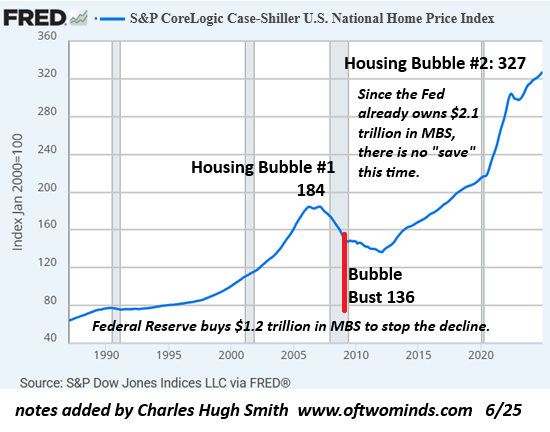

Our Privacy Policy:


Correspondents' email is strictly confidential. This site does not collect digital data from visitors or distribute cookies. Advertisements served by a third-party advertising network (Investing Channel) may use cookies or collect information from visitors for the purpose of Interest-Based Advertising; if you wish to opt out of Interest-Based Advertising, please go to Opt out of interest-based advertising (The Network Advertising Initiative). If you have other privacy concerns relating to advertisements, please contact advertisers directly. Websites and blog links on the site's blog roll are posted at my discretion.


PRIVACY NOTICE FOR EEA INDIVIDUALS


This section covers disclosures on the General Data Protection Regulation (GDPR) for users residing within EEA only. GDPR replaces the existing Directive 95/46/ec, and aims at harmonizing data protection laws in the EU that are fit for purpose in the digital age. The primary objective of the GDPR is to give citizens back control of their personal data. Please follow the link below to access InvestingChannel’s General Data Protection Notice. https://stg.media.investingchannel.com/gdpr-notice/


Notice of Compliance with The California Consumer Protection Act
This site does not collect digital data from visitors or distribute cookies. Advertisements served by a third-party advertising network (Investing Channel) may use cookies or collect information from visitors for the purpose of Interest-Based Advertising. If you do not want any personal information that may be collected by third-party advertising to be sold, please follow the instructions on this page: Limit the Use of My Sensitive Personal Information.


Regarding Cookies:


This site does not collect digital data from visitors or distribute cookies. Advertisements served by third-party advertising networks such as Investing Channel may use cookies or collect information from visitors for the purpose of Interest-Based Advertising; if you wish to opt out of Interest-Based Advertising, please go to Opt out of interest-based advertising (The Network Advertising Initiative) If you have other privacy concerns relating to advertisements, please contact advertisers directly.


Our Commission Policy:

As an Amazon Associate I earn from qualifying purchases. I also earn a commission on purchases of precious metals via BullionVault. I receive no fees or compensation for any other non-advertising links or content posted on my site.

  © Blogger templates Newspaper III by Ourblogtemplates.com 2008

Back to TOP