As systemic risks rise, what matters is the thickness of one's buffers against bad things happening. Those with wealth, power and privilege have sea walls, the rest of us have crumbling sand castles.
Risk and Privilege are intertwined in ways that define our lives and the system we inhabit. Privilege boils down to being buffered from risk, and this is scale-invariant, meaning that it works in the same way from the individual to the nation-state: wealth and power serve to insulate us from risk. Those without wealth and power are fully exposed to risk.
Concrete examples illustrate this dynamic. A rich kid and a poor kid both get busted for possession of Schedule 1 drugs. The rich kid's parents hire a hot-shot attorney who opts for a trial by judge not a jury, as the judge's kids go to the same private school as the attorney's kids and the rich kid.
This defendant shouldn't have his productive life ruined by a youthful indiscretion, blah blah blah. The rich kid gets probation.
The overwhelmed public defender who has maybe ten minutes for the poor kid's case tells the poor kid, you're looking at a maximum of ten years, it's open and shut, what the prosecutor will accept is a plea bargain where you plead guilty to a lesser charge, they get the conviction and you'll be out in a year. The poor kid has no choice and takes the plea bargain. Now he's a felon, on a much different track into adulthood than the rich kid.
Same crime, same process, different outcome.
On the scale of mega-corporations, the same gearing operates. Having a "friendly" senator with seniority privileges who can insert a tax break designed solely to benefit one corporation into must-pass legislation is standard practice for companies that distribute millions of dollars in campaign contributions and lobbying fees.
Smaller scale businesses have no equivalent access to government subsidies.
Same business sector, same system, different outcome.
Nation-states that have the privilege of "printing" money that others accept in payment have an unmatched buffer against risk because they can create financial buffers: if a bad thing happens, fresh money either makes it go away or mitigates the fallout.
On the largest scale--the entire socio-political-economic system--the buffers against risk have been transferred from the lower classes to the upper class, corporations and insiders, all of whom hold privileges enforced by the government.
Over the past 50+ years, the buffers against risk that were once part of the social contract for the bottom 90% have been chipped away or withdrawn. Affordable higher education: withdrawn, gone. Pensions above and beyond Social Security: withdrawn except for government employees. Affordable healthcare: withdrawn from all those who don't have a permanent high-level job in Corporate America (janitorial services, etc. are all contracted out to companies with near-zero benefits) or the government.
Now employment comes as a 1099--every worker is "self-employed" in the sense they have no pension or healthcare but they're paid as employees, not as self-employed workers who control what they charge and what work they do.
Many people are like me: we pay more in "self-employment" taxes (the 15.3% Social Security/Medicare tax) than we do in income tax as the burdens of pensions and healthcare have been shifted from employers to workers, either partially or totally.
The wealthy have privileges that are so ingrained we take them for granted. Tax rates for capital gains--the vast majority of which flow to the wealthiest few--are taxed at 20%, while 1099 workers pay 15.3% on every dollar up to $184,500 plus 22% for income over $48,475, a total of 37.3%.
Income from capital flows to those who own capital (stocks, bonds) and those who own and control capital (businesses).
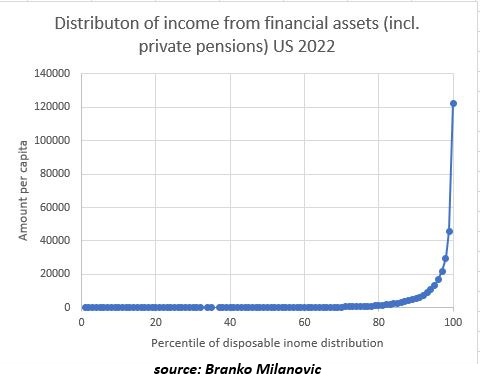
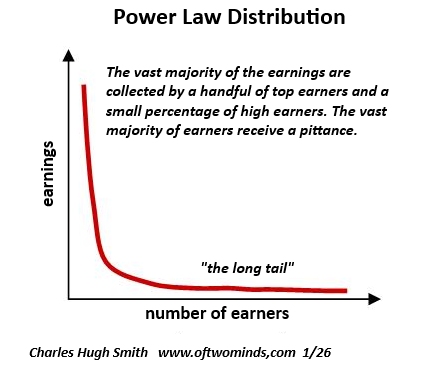
This follows a power-law distribution: the vast majority of the income-producing wealth is held by top 10%, and most of that is held by the top 0.1%.
The point here isn't just the asymmetric distribution--it's the buffers against risk have been dismantled by government policies favoring those with the least exposure to risk. The percentage of the national output / economic activity that is distributed to wage earners has been declining for decades. The money and the privileges it buys have been diverted to benefit capital.
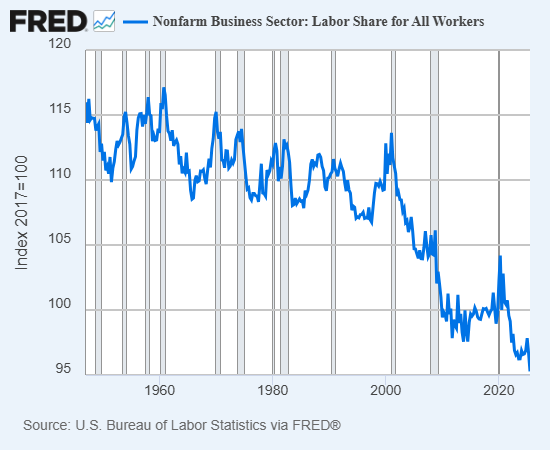
This is what's different now: apologists can claim that "the rich have always collected most of the income and owned most of the wealth," but that's not the point: the point is the buffers against risk have been dismantled as policy decisions that favored the already-wealthy and already-privileged who already had ample buffers against risk.
For the bottom 80%, the lifestyle you ordered is out of stock. For the top 10%, the serial credit-asset bubbles have fattened their wealth and income. Risk for them is now concentrated in The Everything Bubble: should it pop, their buffers will melt like sand castles in a rising tide of risk.
Those in the 81%-89% bracket reckon they're "almost rich" but this is aspirational delusion: the ladder up is missing rungs and the slide down is very slick indeed.
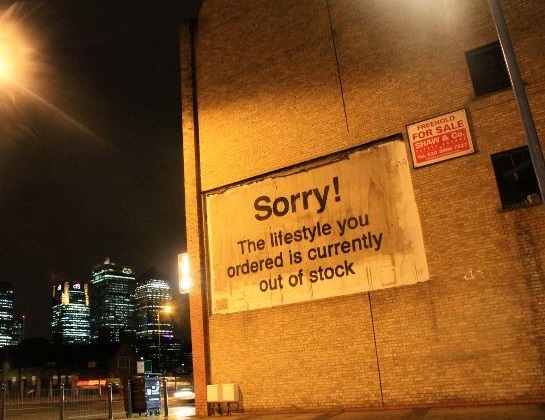
As systemic risks rise, what matters is the thickness of one's buffers against bad things happening. Those with wealth, power and privilege have sea walls, the rest of us have crumbling sand castles. It wasn't always this imbalanced and precarious, and that change will have consequences few anticipate and no one will fully control.
My book Investing In Revolution is available at a 10% discount ($18 for the paperback, $24 for the hardcover and $8.95 for the ebook edition).
Introduction (free)
Check out my updated Books and Films.
Become
a $3/month patron of my work via patreon.com
Subscribe to my Substack for free
NOTE: Contributions/subscriptions are acknowledged in the order received. Your name and email
remain confidential and will not be given to any other individual, company or agency.
|
Thank you, Glenn W. ($70), for your magnificently generous subscription
to this site -- I am greatly honored by your support and readership.
|
|
Thank you, Sebastian S. ($80), for your marvelously generous subscription
to this site -- I am greatly honored by your support and readership.
|
|
Thank you, JJA T. ($70) for your superbly generous subscription
to this site -- I am greatly honored by your support and readership.
|
|
Thank you, Louis N. ($7/month) for your splendidly generous subscription
to this site -- I am greatly honored by your support and readership.
|