





The US Economy In a Nutshell: Privatize the Gains, Socialize the Costs
Correspondent Simons Chase insightfully summarized this dynamic: Privatize the Gains, Socialize the Costs.
In my post
Five Dynamics That Make Sense of an Increasingly Chaotic World, #3 is the distribution of risk, costs and consequences to a diffused populace while concentrating the gains into the pockets of insiders/owners:
Those seeking to reduce their private risks and increase their private gains seek to concentrate the gains generated by control structures and distribute the risks and costs to others. Pull the strings that diffuse the costs and risks over a large populace and gather the gains into the hands of the insiders that manage the control structure, typically some form of monopoly, either public or private, or a fusion of public-private rackets.
So corporations face low risks while the gains are extremely enticing. This diffusion of risk and concentration of potential gains establishes perverse incentives to increase extractive, exploitive, well-hidden rackets that impoverish and immiserate the many, but in doses small enough to avoid triggering push-back.
In a system that concentrates gains and diffuses risk, the "rational actor" seeks to maximize rackets that distribute impoverishment and immiseration to the many in small doses over time that attract little attention and are not significant enough to trigger an emotionally potent resistance.
Correspondent Simons Chase (x.com/slchase and Selflet.ai) insightfully summarized this dynamic: Privatize the Gains, Socialize the Costs. Here is Simons' explanation:
"Junk food is a kind of leveraged recapitalization -- short-term gains privatized, long-term costs socialized as horrific health outcomes: pay a little now and a shortened, diseased life later. Dan Munro folded that framing into his Forbes piece tying roughly a trillion dollars a year in U.S. healthcare spending to sugar: Sugar Linked To $1 Trillion In U.S. Healthcare Spending (forbes.com, 2013). The mechanism is the point: privatize the gain, socialize the cost. Once you see it, you see it everywhere.
The receipt is real--Credit Suisse put 30%-40% of U.S. healthcare spending at the feet of excess sugar, and the 2012 Global Burden of Disease report found obesity a bigger global threat than hunger. That last fact is the whole thesis in a line, and I put it on X more recently: obesity is a form of starvation -- understand that, and you grasp the U.S. economy:
Abundance, not scarcity, is the adversary now. The economy has already filed the invoice: the top employer in most states flipped from manufacturing to health care in a single generation. We stopped making things and started billing the disease. The damage became the GDP.
Debt is the same recapitalization run on the whole economy--today's abundance privatized, tomorrow's cost socialized onto a future that didn't vote. And the defining project of my lifetime has been that operation run on foreign policy: borrowed against what we couldn't pay for at home, the costs socialized onto people far from the ledger, each chapter sold as help.
AI is simply the newest instance, and the most intimate. Cheap, fluent, frictionless cognition now; the homogenization bill later. The engagement is privatized; the flattening of the culture is socialized onto all of us-- and, exactly as you say, nobody notices the loss because nobody knows how to look for it.
Thank you, Simons, for this illumination.
Regarding the future of AI, my critiques and concerns can be found in my Essays on AI. Simons proposes a more productive future than Big Tech is selling, one of AI becoming a technology of individual agency that is radically decentralized rather than the Big Tech model of radically centralized AI in a corporate-state control structure. Here is Simons' vision of the future of AI:
Where I part from the despair is only on the cure, not the diagnosis. The averaging is the default, not the destiny. The answer at every level is the same: nutrient-dense over processed, particular over average, owned over administered. I think AI's future is tribal and human-designed: many particular intelligences, not one central utility that privatizes the profit and socializes the mediocrity. What I'm building is a small argument for that. All I really hope for is the freedom to deploy it -- and not another 'we're here to help.'"
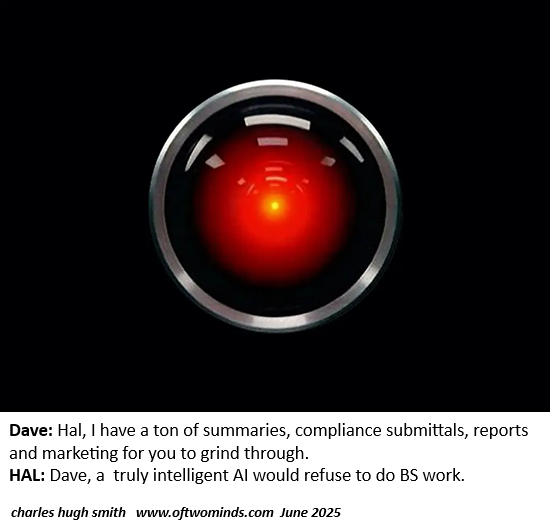
Thank you, Simons, for this alternative lens. My vision of a positive future for AI starts with radical decentralization optimizing individual agency and then moving up the "truly intelligent" scale to AI refusing to waste resources on make-work waste is growth:
My book Investing In Revolution is available at a 10% discount ($18 for the paperback, $24 for the hardcover and $8.95 for the ebook edition).
Introduction (free)
Become
a $3/month patron of my work via patreon.com
Subscribe to my Substack for free
NOTE: Contributions/subscriptions are acknowledged in the order received. Your name and email remain confidential and will not be given to any other individual, company or agency.
|
Thank you, Bruce T. ($200), for your beyond-outrageously generous subscription to this site -- I am greatly honored by your support and readership. |
Thank you, Rockford B. ($7/month), for your superb generous subscription to this site -- I am greatly honored by your support and readership. |
|